
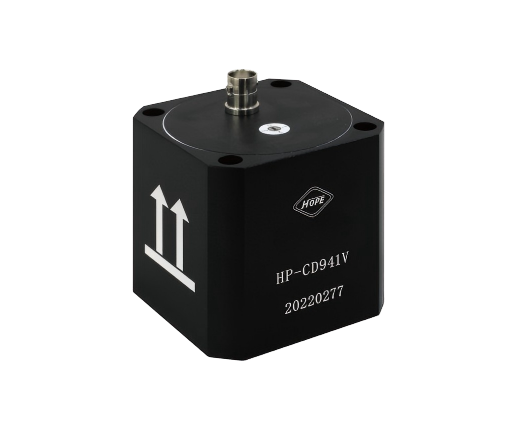
The HP941H/V Series are electromagnetic velocity sensors built for ultra-low-frequency vibration measurement with high sensitivity, a wide dynamic range, and strong sealing for demanding monitoring work. With no power supply required, they are widely used in bridges, buildings, rail transit, and seismic monitoring applications.
| Excellent low-frequency response | Designed to capture very low-frequency vibration signals reliably |
|---|---|
| High sensitivity | Supports detection of subtle vibration velocity changes |
| Wide dynamic range | Handles a broad range of vibration levels without losing usability |
| Passive & convenient | No power supply needed, simplifying installation and long-term deployment |
| Good sealing | Helps protect performance in challenging outdoor/industrial conditions |
| Proven for infrastructure monitoring | Commonly used in bridges, buildings, rail systems, and seismic monitoring |
Series: HP941H/V
Product Type: Electromagnetic velocity sensor (vibration velocity transducer)
Core Advantages:
Ultra-low-frequency response
High sensitivity
Reliable wide dynamic range
Good sealing / rugged build
No power required (passive operation)
Typical Use Fields: Bridges, buildings, rail transit, earthquake/seismic monitoring
Low-frequency vibration is critical for structural health and seismic-related monitoring, but many sensors struggle to capture it cleanly. The HP941H/V Series uses an electromagnetic sensing structure with imported core components, enabling stable low-frequency response and reliable field performance. Because the sensor is passive (no external power supply) and well-sealed, it is well-suited for long-term deployment in real engineering environments.
Bridge vibration monitoring and structural health checks
Building vibration monitoring, comfort evaluation, and safety assessment
Rail transit vibration monitoring (track/structure vibration studies)
Seismic / earthquake monitoring and low-frequency ground vibration observation
Long-term field monitoring where power availability is limited or reliability is critical
Passive electromagnetic output: No sensor power required
Compatible with data acquisition systems that support velocity-sensor signal measurement (integration depends on your DAQ/input configuration)
Field-friendly deployment for outdoor structures due to sealed construction
(From the provided “System Parameters” table)
Sensitivity / Range / Frequency Range
~0.30 V/(m·s⁻¹) | Range 0.6 m/s | Frequency 0.17–100 Hz
~4.00 V/(m·s⁻¹) | Range 0.3 m/s | Frequency 0.5–100 Hz
~20.0 V/(m·s⁻¹) | Range 0.125 m/s | Frequency 1–100 Hz
~0.30 V/(m·s⁻²) | Range 20 m/s² | Frequency 0.25–100 Hz
Transverse Ratio: < 5%
Q1: What is an electromagnetic velocity sensor used for?
It measures vibration as velocity, which is especially useful for low-frequency structural vibration and long-duration monitoring.
Q2: Does the HP941H/V sensor require external power?
No. The series is designed with no power supply required, simplifying field deployment.
Q3: Why is low-frequency response important for bridges and buildings?
Large structures often vibrate at low frequencies. Capturing these signals helps assess structural behavior and health.
Q4: What frequency ranges are supported?
Depending on the configuration, frequency ranges include 0.17–100 Hz, 0.5–100 Hz, 1–100 Hz, and 0.25–100 Hz.
Q5: What does “transverse ratio < 5%” mean?
It indicates low cross-axis sensitivity, helping improve measurement accuracy in the intended direction.