
| Fast installation (no soldering) | quick-plug terminals reduce wiring effort and avoid solder-joint failures in multi-channel field setups. |
|---|---|
| Wireless mesh networking | Zigbee self-organizing network, max distance 200 m, easy multi-unit grouping, scalable up to 256 channels, simple on-site deployment. |
| High performance acquisition | 24-bit ADC, all channels synchronized at 10 Hz, high test accuracy (feature spec: up to 0.2% ±2 με). |
| Modular & portable | lightweight modular design, small footprint, easy to carry and expand. |
| Long battery life | low-power design with built-in rechargeable lithium battery; up to 16 hours standalone operation (suitable for outdoor grouping tests). |
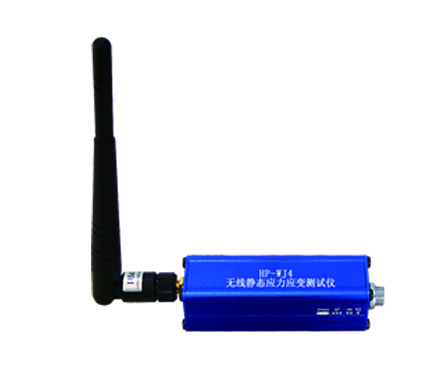
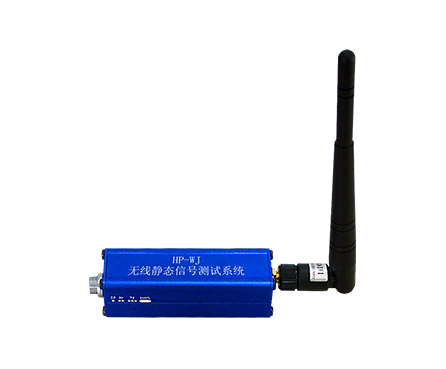
HP-WJ is a compact, modular wireless static strain measurement device designed for multi-point testing without on-site soldering or complex wiring. It supports Zigbee mesh self-networking (up to 200 m per link) and can be expanded for large channel-count deployments (up to 256 channels). It also supports NB-IoT transmission for long-distance/remote data delivery.
Wireless static strain/stress testing with flexible sampling (from high-rate logging to ultra-low-rate long-term monitoring).
Designed for field environments with protection against weather and dust (IP-rated).
Suitable for distributed measurement points where wiring is difficult, risky, or expensive.
Channels per module: 4 channels
Sampling rate (per channel): 10 samples/sec down to 1 sample/day (software remote setting)
ADC resolution: 24-bit
Measurement accuracy: 0.2% ±2 digits (table spec)
Data storage: Built-in 32 GB TF card
Communication: Zigbee mesh networking or NB-IoT transmission (distance not limited for NB-IoT)
Power: Built-in 4.2 V / 4 Ah lithium battery; optional solar charging module
Strain: ±3000 ~ ±100000 με
Voltage: ±100 mV, ±500 mV, ±1 V, ±2.5 V
Current: 0–20 mA, 4–20 mA
Temperature: RTD, thermocouple, thermal resistance, etc.
Other: transmitter outputs such as voltage/current/resistance output types
Bridge configurations: full bridge, half bridge, quarter bridge (2-wire), quarter bridge (3-wire), quarter-bridge compensation
Excitation supply: DC 2 V
Operating temperature: −20 to 60 °C
Humidity: 10–95% RH
Protection: rain-resistant, dust-resistant, shock-resistant; IP65
Dimensions: 105 × 68 × 25 mm (L × W × H)
Structural testing / civil engineering: bridge, tunnel, building strain monitoring (short-term tests or long-term logging)
Mechanical & materials testing: static strain distribution, load/deflection correlation studies
Field experiments: outdoor measurement where wiring is difficult (temporary setups, remote sites)
Industrial monitoring: current/voltage/transmitter signal monitoring with wireless data collection
Typical deployment flow
Install strain gauges / sensors and connect via the quick-plug terminals (no soldering on the instrument side).
Power on modules and form a Zigbee mesh (or enable NB-IoT mode if required).
Set sampling rate remotely (from 10 Hz to 1/day per channel).
Log data to the 32 GB TF card and/or transmit to your remote endpoint.
Notes
For large deployments, plan Zigbee node placement to maintain mesh connectivity (your sheet states up to 200 m max distance).
For long-term outdoor operation, consider the optional solar charging module.
Q1: Is HP-WJ for dynamic tests?
A: HP-WJ is positioned for wireless static strain measurement with up to 10 Hz synchronized sampling.
Q2: How many channels can one system support?
A: The series supports distributed grouping and can be expanded up to 256 channels (via networking/grouping).
Q3: What wireless options are available?
A: Zigbee mesh self-networking and NB-IoT transmission are supported (NB-IoT is noted as distance-unlimited).
Q4: Can it store data locally without a PC?
A: Yes. It includes a built-in 32 GB TF card for local data logging.
Q5: What is the environmental rating?
A: The unit is designed for field use and lists IP65, with −20 to 60 °C operating range.
Q6: How long can it run on battery?
A: The sheet states up to 16 hours standalone operation with the built-in rechargeable battery.