
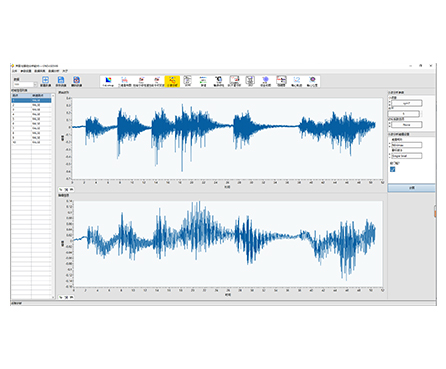
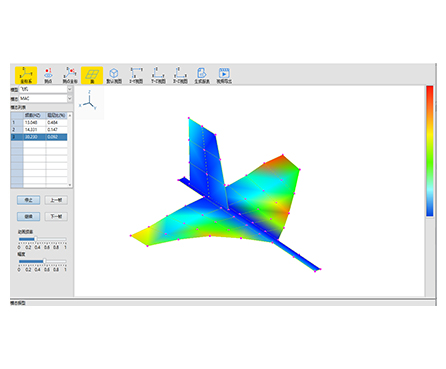
HP-STAP Wavelet Analysis Software helps you analyze non-stationary signals with localized time (or space) + frequency insight. Using wavelet transform and multi-scale refinement, it lets you zoom into transient details that are hard to interpret with traditional Fourier-only analysis.
| Time-Frequency Localization | Pinpoint transient events and frequency changes precisely over time. |
|---|---|
| Multi-Scale Insight | Analyze both slow trends and fast shocks in one workflow. |
| Better Transient Interpretation | Improve interpretability for non-stationary signals where classic Fourier views can blur timing information. |
| Detail-First Diagnostics | Zoom into any signal segment to validate root causes and micro-patterns faster. |
Series: HP-STAP
Product: Wavelet Analysis Software
Core method: Wavelet transform for time/space–frequency localized analysis
Key capability: Multi-scale refinement via scaling (stretching) and translation (shifting) operations to progressively analyze signal details
Localized analysis (time/space + frequency): Identifies when a frequency component happens, not just what frequencies exist.
Multi-resolution (multi-scale) refinement:
Higher frequencies → finer time resolution
Lower frequencies → finer frequency resolution
Adaptive detail focusing: Automatically supports deeper inspection of any portion of the signal to reduce the “hard-to-catch transient” problem common in pure Fourier analysis.
Vibration and rotating machinery diagnostics (transients, impacts, modulation)
Acoustic and noise event analysis (bursts, clicks, short-duration anomalies)
Electrical waveform analysis (switching events, intermittent disturbances)
R&D signal exploration for non-stationary processes (prototype validation, anomaly hunting)
Any scenario requiring time–frequency analysis rather than frequency-only summaries
Works with sampled time-domain signals (waveforms) commonly produced by data acquisition systems.
Suitable for signals coming from typical industrial/test sensors (e.g., vibration, acoustic, electrical), as long as the data is available as a time series.
Analysis type: Time/space–frequency localized analysis (Wavelet Transform)
Resolution behavior: High frequency → finer time; low frequency → finer frequency
Core operations: Scaling (dilation/stretching) + translation (shifting) for multi-scale refinement
Outcome: Enhanced interpretability for non-stationary / transient-rich signals compared with frequency-only approaches
Q1: What problem does wavelet analysis solve compared with FFT/Fourier?
Wavelet methods show both time and frequency information, making them well-suited for signals whose frequency content changes over time (bursts, impacts, transient faults).
Q2: When should I use wavelet analysis?
Use it when the signal is non-stationary (features evolve over time) or when you need to locate where a frequency event happens.
Q3: What does “multi-resolution” mean in practice?
It means you can view the same signal at multiple scales: better timing detail at high frequencies and better frequency detail at low frequencies—helpful for mixed behaviors in one waveform.
Q4: Can I focus on a small portion of the waveform?
Yes—wavelet workflows are built for zooming into localized details and interpreting short-lived events more clearly than frequency-only summaries.