
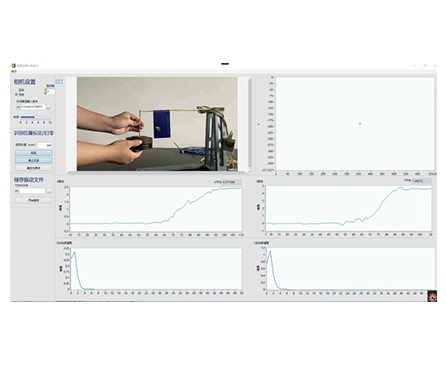
HP-STAP is a visual (video-based) vibration and displacement measurement software designed to extract low-frequency displacement or vibration data from recorded videos. By combining target-feature detection, motion tracking, curve solving, and spectrum analysis, it helps engineers evaluate deformation, deflection, and displacement behavior of structures or test objects quickly and accurately.
| Non-contact measurement | Capture displacement/vibration without attaching sensors to the object. |
|---|---|
| Low-frequency motion capture | Extract low-frequency displacement or vibration information from video. |
| Feature detection | Automatically detect target features for robust tracking. |
| Motion tracking | Track feature movement to derive displacement and vibration trends. |
| Curve reconstruction | Generate displacement and vibration curves from tracked motion. |
| Spectrum analysis | Convert time-domain vibration into frequency-domain insights for diagnosis. |
| Fast evaluation | Quickly assess structural or object performance under working conditions. |
Product name: HP-STAP Series
Type: Visual vibration & displacement testing / analysis software
Measurement method: Video measurement + motion tracking (non-contact, image-based)
Typical outputs: Displacement curves, vibration curves, deformation/deflection trends, frequency-domain results (spectrum)
HP-STAP uses video measurement analysis to capture and analyze low-frequency displacement or vibration video images of a structure or a test object. The software identifies target features, tracks their motion over time, reconstructs displacement/vibration curves, and performs spectrum analysis—making it easier to understand real operating-state behavior such as deformation, deflection, and displacement response.
Structural deformation/deflection evaluation under working conditions
Low-frequency vibration monitoring and verification
Displacement trend tracking for test objects during lab or field tests
Comparative testing (before/after modification, different fixtures, different loads)
R&D validation for mechanical components and assemblies
Primary input: Video images (captured from the structure or test object during motion)
Compatible sources: Video recorded by your camera system (e.g., industrial or high-speed cameras, depending on your setup)
Practical note: The measurable vibration frequency range depends on the video frame rate and recording quality (higher FPS generally supports higher-frequency analysis).
(The image provided does not list numeric specs. Below are the standard “spec items” buyers usually request—fill in with your official data if available.)
Supported video formats: (e.g., MP4/AVI/MOV) — TBD by your official spec
Tracking method: Target feature detection + motion tracking
Analysis functions: Displacement/vibration curve solving, spectrum analysis
Outputs/export: Curves, analysis results, reports — TBD by your official spec
Recommended camera requirements: Frame rate & resolution — Depends on test needs
1) What is video-based vibration/displacement measurement?
It’s a method that extracts displacement or vibration information from video by detecting and tracking target features frame-by-frame, then calculating motion curves and frequency-domain results.
2) What kind of motion can HP-STAP analyze?
It is intended for low-frequency displacement or vibration captured in videos, including deformation, deflection, and displacement curve behaviors under working conditions.
3) Do I need physical sensors like accelerometers?
Not necessarily. HP-STAP is designed for visual, non-contact measurement using video. (Some users still combine sensors + video when they want cross-validation.)
4) How accurate is the result?
Accuracy depends on the video quality, camera stability, calibration approach, lighting, and feature visibility. Better capture conditions typically yield more reliable tracking and curve results.
5) Can I perform frequency-domain analysis (FFT/spectrum)?
Yes. HP-STAP includes spectrum analysis to help identify dominant frequencies and vibration characteristics from the motion signal.