
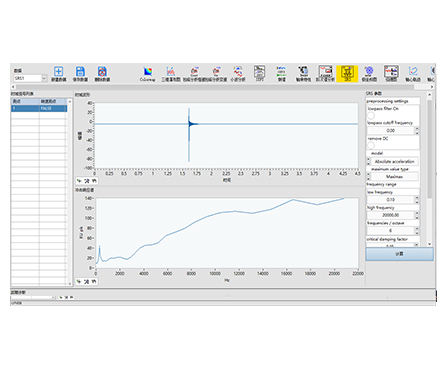
HP-STAP SRS Analysis Software is built for shock testing and impact signal evaluation using Shock Response Spectrum (SRS) methods. It supports multiple SRS calculation types—including weighted SRS at common octave/fractional-octave bands—and lets you adjust damping ratio (amplification factor) to match real-world test standards.
| Complete SRS toolkit | Supports standard SRS plus weighted, residual, and maximum shock spectrum outputs |
|---|---|
| Multi-band weighted SRS | Provides weighted shock spectra at common 1/1, 1/3, 1/6, 1, 1/12, 1/24 bands for clear comparison and reporting |
| Adjustable damping / Q control | Tune damping ratio (amplification factor) to match your test requirements |
| More reliable shock evaluation | Converts raw impact waveforms into a clearer engineering metric for acceptance, comparison, and documentation |
Series: HP-STAP
Product Type: SRS (Shock Response Spectrum) analysis software
Core Outputs Supported:
Shock Response Spectrum (SRS)
Weighted shock spectrum at 1/1, 1/3, 1/6, 1, 1/12, 1/24 bands
Residual shock spectrum
Maximum shock spectrum
Key Adjustable Parameter: Damping ratio (amplification factor) configurable
Shock signals are fast, high-energy, and difficult to evaluate with FFT alone. SRS converts an impact waveform into a spectrum-like representation that shows how a set of single-degree-of-freedom (SDOF) oscillators would respond to the shock. HP-STAP provides a practical SRS workflow with multiple spectrum types and banded/weighted displays, so engineers can compare shocks, validate test levels, and document results with consistency.
Shock and impact testing for products, components, and assemblies
Packaging shock evaluation and drop-test waveform assessment
Transportation and handling shock characterization
Durability/reliability engineering and qualification testing
Comparing multiple shock events to identify worst-case conditions (maximum spectrum)
(Kept general to avoid adding specs not shown in the image.)
Works with time-domain shock/impact signals typically captured in test environments (e.g., acceleration or similar transient measurements)
Suitable for workflows that require SRS metrics for test validation and reporting
(Based strictly on the image’s listed features—no invented numeric ranges.)
SRS result types:
Shock response spectrum
Weighted shock spectrum (1/1, 1/3, 1/6, 1, 1/12, 1/24)
Residual shock spectrum
Maximum shock spectrum
Damping ratio (amplification factor): adjustable
Q1: What is SRS (Shock Response Spectrum)?
SRS is a method that converts a shock waveform into a spectrum-like curve representing how systems would respond to the shock, making impact severity easier to compare.
Q2: What’s the difference between weighted, residual, and maximum shock spectra?
They are different SRS result representations used for analysis and comparison. HP-STAP supports weighted shock spectra, residual shock spectra, and maximum shock spectra as listed.
Q3: Why is damping ratio (amplification factor) important?
SRS results depend on damping. Adjusting damping ratio (or amplification factor/Q) helps align calculations with your test method and acceptance criteria.
Q4: When should I use banded/weighted SRS (1/3, 1/12, 1/24, etc.)?
Use weighted/banded SRS when you need standardized band representations for comparison, reporting, or consistency across multiple shock tests.
Q5: Is SRS used only for acceleration signals?
SRS is most common with shock acceleration waveforms, but the key requirement is a time-domain transient signal suitable for shock response evaluation.