
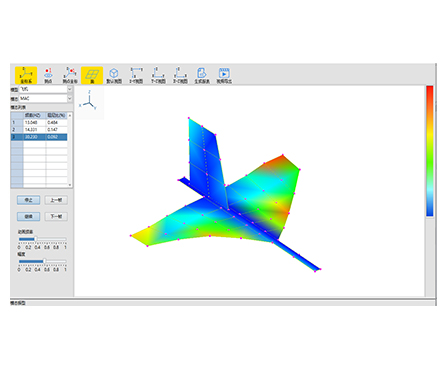
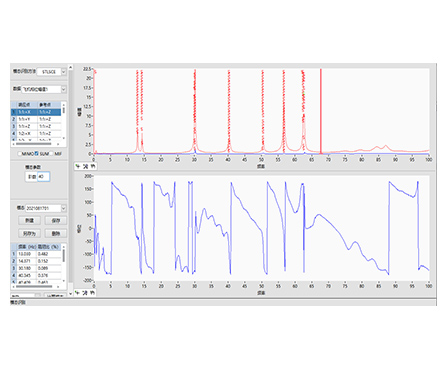
HP-MTAS is an advanced modal testing analysis software suite built for experimental modal analysis (EMA) and operational deflection shape (ODS) visualization. It helps engineers estimate frequency response functions (FRFs), identify modal parameters, validate mode shapes, and export clear animations and reports—so vibration issues can be seen, quantified, and communicated quickly.
| Multi-estimator FRF (H1–H4) | Improves accuracy under different noise conditions and test setups. |
|---|---|
| Coherence & quality checks | Helps validate measurement reliability before curve fitting. |
| SDOF/MDOF curve fitting | Speeds up modal extraction and reduces manual tuning. |
| Multi-reference fitting | Handles complex structures with multiple excitations more efficiently. |
| Time/Frequency animation | Lets teams “see” vibration behavior for faster decision-making. |
| Mode shape visualization | Makes resonance modes easier to interpret and communicate. |
| ODS analysis (Time & Frequency) | Reveals real operating deflection patterns for troubleshooting. |
| SUM FRF & MIF indicators | Supports quick resonance screening and mode confirmation. |
| Stabilization diagram support | Increases confidence in identified modes and reduces false picks. |
| Report & video export | Produces client-ready deliverables with less formatting effort. |
| Geometry import (external model/TXT) | Cuts setup time and improves repeatability across projects. |
| Sub-structuring modeling | Supports modular analysis for large or assembled structures. |
Product line: HP-MTAS Series
Product type: Advanced modal testing & analysis software
Core functions: FRF estimation (H1/H2/H3/H4), coherence calculation, curve fitting (SDOF/MDOF), modal parameter identification, mode shape display, time/frequency animation, ODS analysis, report & video export
Modeling: Geometry modeling with external model + TXT import; sub-structuring modeling
HP-MTAS supports the full workflow of modal testing analysis:
Build or import a geometry model
Compute FRFs with multiple estimators (H1/H2/H3/H4)
Run SDOF/MDOF curve fitting and multi-reference fitting
Perform modal parameter identification with multiple identification methods
Visualize mode shapes, ODS, and time/frequency animations
Apply modal validation criteria and generate reports/videos
Experimental modal analysis for products, structures, and assemblies
FEA/CAE correlation and model validation via measured mode shapes
Troubleshooting noise & vibration issues (rattles, resonance, fatigue risks)
Operational Deflection Shape (ODS) visualization for running machinery/structures (time-based or frequency-based ODS workflows are commonly used in industry).
Modal testing projects in automotive, aerospace, electronics, machinery, appliances, and academic research
Supports modal test datasets that include excitation + response signals for FRF computation (including multi-reference workflows)
Works with multi-point measurements and displays per-point amplitude values directly on the model
Geometry input supports external model import and TXT import, enabling fast setup and reuse across projects
(If you share what sensors/DAQ you use—accelerometers, impact hammer, shaker, laser vibrometer, etc.—I can tailor this section into a compatibility-focused version.)
FRF & Signal Functions
FRF estimators: H1 / H2 / H3 / H4
Coherence function calculation
Batch FRF computation
Global functions: sum FRF (SUM), Mode Indicator Function (MIF)
Modeling & Visualization
Geometry modeling
Mode shape display
Time-domain and frequency-domain animation
Report export + video export
Substructure modeling
Numeric amplitude display at each measurement point
Curve Fitting & Identification
Curve fitting: SDOF, MDOF, Multi-reference curve fitting
Identification methods: FDPI, LSCE, STLSCE, SSI, plus stabilization diagram and auto-spectrum / cross-spectrum support
ODS
Operational deflection shape analysis: Time-domain ODS and Frequency-domain ODS
1) What problems does HP-MTAS solve?
It streamlines modal testing analysis—from FRF estimation and curve fitting to mode shape/ODS visualization and reporting—so you can identify resonances, extract modal parameters, and document results.
2) What’s the difference between ODS and modal analysis (EMA)?
ODS visualizes real operating motion shapes (often time-based or frequency-based), while EMA typically relies on FRFs and curve fitting to extract modal parameters.
3) Why offer multiple FRF estimators (H1–H4)?
Different estimators help handle different noise conditions and measurement setups. Having H1–H4 improves robustness across varied test environments.
4) Does it support multi-reference testing?
Yes—HP-MTAS supports multi-reference curve fitting and related displays (including SUM FRF and MIF).
5) Can I import geometry instead of building it from scratch?
Yes—geometry modeling supports external model import and TXT import, plus substructure modeling.