
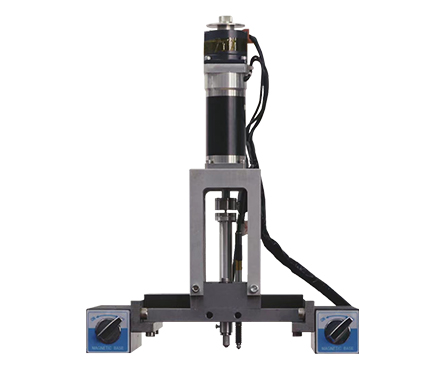
The HP-MPT Series is a portable continuous indentation tester designed for on-site, non-destructive evaluation of material mechanical performance. It helps assess aging and safety risks in critical assets (such as pipelines and pressure equipment) without destructive sampling or laboratory-only workflows.
| Non-destructive testing | Damage-free checks without cutting samples from equipment |
|---|---|
| On-site efficiency | Fast testing for field inspection workflows |
| Reliable data capture | High sampling rate supports stable force–depth measurement |
| Practical for aging assessment | Supports periodic monitoring to evaluate degradation and safety |
| Breaks lab dependency | Moves testing from laboratory to field, improving feasibility for routine checks |
Product line: HP-MPT Series
Product type: Continuous indentation (instrumented indentation) mechanical property testing instrument
Primary purpose: Periodic field testing to support safety evaluation and aging assessment
Core value: Replaces destructive sampling + lab checks with simple, fast, reliable, damage-free on-equipment testing
Indenter options: Tungsten carbide ball indenter + 136° Vickers diamond indenter (depending on configuration)
To prevent leakage, fatigue failure, and strength degradation in long-service equipment, key material indicators need periodic verification. Traditional methods often rely on destructive sampling and laboratory testing, making routine checks on installed equipment difficult.
The HP-MPT Series uses continuous indentation to capture force–displacement data and support on-site evaluation of mechanical performance. This approach modernizes field inspection by enabling practical testing directly on equipment, improving inspection efficiency while avoiding damage from sample removal.
Pipeline integrity checks (in-service pipelines)
Pressure vessels and pressure equipment inspections
On-site material condition evaluation for aging and safety assessment
Field verification where destructive sampling is impractical or not allowed
Measured signals: Load (force) and indentation depth (displacement) with stated resolution
Indenter support:
Tungsten carbide ball indenter (e.g., Ø500 μm; some configs allow Ø1 mm)
136° Vickers diamond indenter
Data acquisition: Up to 100 samples/second (per specification)
Configuration A (Force unit: N)
Max load: 1000 N (Max)
Load/depth resolution: 5 N / 0.1 μm
Loading speed: 55–100 mm/min
Data acquisition rate: 100 / sec
Indentation depth: 150 μm
Indenter: Ø500 μm tungsten carbide ball + 136° Vickers diamond
Dimensions: 60 × 80 × 295 mm
Main unit weight: 1.5 kg
Configuration B (Force unit: kgf / gf)
Max load: 100 kgf (Max)
Load/depth resolution: 5 gf / 0.1 μm
Indenter vertical travel: 30 mm
Loading speed: 5–100 mm/min
Data acquisition rate: 100 / sec (20 ms)
Indentation depth: 150 μm
Indenter diameter: 500 μm or 1 mm
Indenter shape: Ball indenter + 136° Vickers indenter
Operating temperature: −10°C to +40°C
Operating humidity: < 65% RH
Test range: Macro scale
1) Is the HP-MPT Series destructive?
No. It is designed for non-destructive, damage-free on-site testing without removing material samples.
2) Why use continuous indentation instead of traditional lab tests?
Traditional methods often require destructive sampling and lab access. HP-MPT enables field testing directly on equipment, improving feasibility for routine inspections.
3) What can it be used to evaluate?
It supports evaluation of mechanical performance trends for aging and safety assessment by capturing load–depth data via indentation.
4) What indenter types are supported?
Supported options include a tungsten carbide ball indenter and a 136° Vickers diamond indenter (exact sizes depend on configuration).
5) What is the maximum indentation depth?
The specification lists 150 μm.
6) How fast is data collected?
The system supports up to 100 samples per second (per specification).
7) Can it be used outdoors or on industrial sites?
Yes—this product targets on-site inspection. For the kgf/gf configuration, the operating range is −10°C to +40°C and <65% RH.
8) Which configuration should I choose (1000 N vs 100 kgf)?
Choose based on your inspection standard, preferred force units, and indenter needs (e.g., ball size options and travel requirements).