
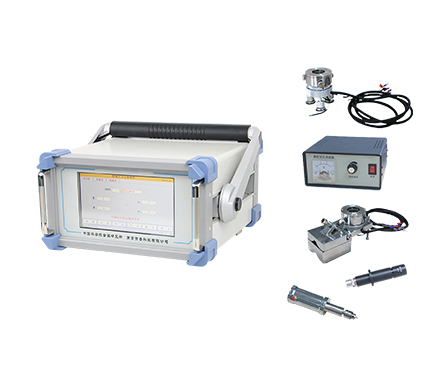
HP-MK2 is a benchtop blind-hole (hole-drilling) residual stress measurement system designed for fast, repeatable near-surface residual stress evaluation. With optical alignment, high-precision micro drilling, and built-in stress calculation on a touchscreen WinCE interface, it helps engineers quantify residual stress efficiently across a wide range of materials and geometries.
| Optical alignment with LED cold light | Helps reduce temperature influence on the strain measurement setup. |
|---|---|
| High-precision positioning | 160× microscope supports 0.006 mm measurement accuracy and 0.01 mm alignment accuracy. |
| Stable micro drilling | Integrated electric drilling with adjustable speed; drilling stability helps reduce location error; drilling precision < 0.01 mm. |
| Works on complex geometries | Supports flexible testing on flat surfaces, curved surfaces, corners, and multiple weld seam types. |
| Fast, easy operation | Designed for practical residual stress testing with quick setup and easy handling. |
Product type: Benchtop blind-hole residual stress testing system
Method: Stress-relief by micro blind-hole drilling + strain (µε) acquisition + stress calculation (MPa)
Alignment system: Optical alignment device with built-in LED cold light source to reduce temperature-related drift
Microscope: 160× tool microscope with scale for precise positioning and measurement
Micro drilling: Integrated high-precision electric drilling unit, adjustable speed, stable drilling with minimal runout
User interface & computing: WinCE system, 7-inch touchscreen, built-in stress calculation / display / storage
Residual stresses from welding, machining, heat treatment, and surface processing can strongly affect fatigue life, distortion, and cracking risk. HP-MK2 supports a blind-hole workflow where a small hole is drilled to relieve stress locally, while strain changes (µε) are recorded and converted into residual stress values (MPa).
It is optimized for precise positioning, stable drilling, and quick on-site style testing, especially around complex weld features and curved surfaces.
Weld residual stress checks (e.g., corner joints, butt welds, lap/fillet-style weld areas)
Heat-treated metal components (distortion / cracking risk screening)
Machined parts (grinding, milling, turning-induced residual stress)
Shot peened / surface-treated parts (process verification)
Maintenance & failure analysis for critical components (fatigue-prone areas)
R&D labs and QA/QC for metalworking and structural manufacturing
4 input channels for strain (µε) acquisition
Designed for residual stress testing data capture where strain changes around a drilled blind hole must be recorded and processed into stress results (MPa).
System Parameters
Input channels: 4 channels
Sampling rate: 10 Hz / channel
Input range: ±30000 µε
Resolution: 0.1 µε
Measurement error: ≤ ±0.1%
Calculation resolution/accuracy: 1 MPa
Stress error: ≤ 10 MPa
Blind-Hole & Drilling
Blind-hole size: φ 1.0 mm
Drilling depth control spacer/block: 2.0 mm (preset hole depth 2.0 mm)
HMI / Data Processing
OS & display: WinCE, 7-inch touchscreen
Functions: Built-in stress calculation, display, and data storage
Optical & Drilling Precision
Tool microscope: 160×
Measurement accuracy: 0.006 mm
Alignment accuracy: 0.01 mm
Drilling precision: < 0.01 mm
1) What does “blind-hole” mean in residual stress testing?
A shallow micro hole is drilled (not through-thickness) to locally relieve residual stress; strain changes are measured and converted into stress results.
2) What kind of results will I get?
Strain (µε) acquisition and computed residual stress values in MPa, with on-screen calculation and stored records.
3) Is HP-MK2 suitable for weld areas?
Yes—its positioning and drilling design is intended for flexible testing on corners and various weld seam areas.
4) What hole size does the system use?
It supports a φ1.0 mm blind hole configuration.
5) How is drilling depth controlled?
A 2.0 mm depth control spacer/block is provided for preset blind-hole depth control.
6) How accurate is the positioning?
With the 160× microscope, positioning/alignment supports 0.01 mm alignment accuracy and 0.006 mm measurement accuracy.
7) How many strain inputs can be recorded at once?
Up to 4 channels, sampled at 10 Hz per channel.
8) Is the system hard to learn?
It’s designed for quick operation with a touchscreen interface and built-in calculation/display/storage functions.