
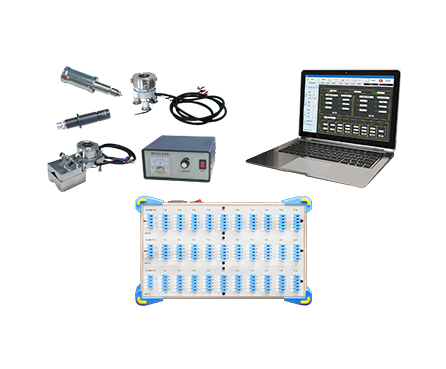
HP-MK1 is a multi-channel residual stress testing system based on the hole-drilling method. It combines an optical strain measurement module (with an LED cold light source) and a precision micro-drilling unit to deliver stable, repeatable strain readings and reliable residual stress calculations—without introducing temperature-drift errors during measurement.
| Cold-light stability | Built-in LED cold light source helps reduce strain measurement drift caused by temperature changes. |
|---|---|
| High measurement precision | Microscope reading accuracy up to 0.006 mm and alignment accuracy 0.01 mm. |
| Smooth micro-drilling | Integrated precision drill with adjustable speed supports stable drilling and reduces positioning error. |
| Flexible on complex geometries | Suitable for flat surfaces, curved surfaces, and multiple weld configurations. |
| Efficient workflow | PC-based processing enables calculation, storage, and visualization in one place. |
HP-MK1 is designed for residual stress evaluation on a wide variety of components and geometries. The optical measurement device uses a 160× tool-scale microscope for accurate strain reading, while the integrated micro-drill provides smooth, adjustable-speed drilling to reduce positioning deviations and improve hole quality.
Model: HP-MK1 (Multi-Channel)
Method: Hole-drilling residual stress measurement
Optical module: Built-in LED cold light source for stable readings (reduced thermal drift)
Microscope: 160× tool-scale microscope for fine measurement and alignment
Micro-drill: Integrated design with automatic power drive and adjustable speed
Use cases: Flat, curved, and welded structures (including corner welds, butt welds, and fillet welds)
Operation: Practical and easy to learn; supports PC-based calculation, storage, and display
Welded structures: corner welds, butt welds, fillet welds
Curved or contoured metal parts and assemblies
Residual stress evaluation in fabrication, repair, and quality verification workflows
Comparative testing across different materials or process parameters
Multi-channel input: Configurable 10–100 channels for strain acquisition (supports multi-point testing).
Optical strain measurement module: Optical readout with 160× microscope and LED cold light source for stable viewing/reading.
PC processing: Data calculation, storage, and display handled on a computer (software-based workflow).
| Item | Specification |
|---|---|
| Input channels | 10–100 channels (optional) |
| Sampling rate | 10 Hz / channel |
| Input range | ±30,000 με |
| Resolution | 0.1 με |
| Measurement error | ≤ ±0.1% |
| Calculation accuracy | 1 MPa |
| Stress error | ≤ 10 MPa |
| Blind hole size | φ1.0 mm |
| Drilling depth control spacer | 2.0 mm (preset hole depth 2.0 mm) |
| Data processing | PC-based calculation / storage / display |
Q1: What is HP-MK1 used for?
A: It is used to measure and evaluate residual stress using the hole-drilling method with multi-channel strain acquisition and PC calculation.
Q2: Will lighting heat affect the strain reading?
A: The optical module uses an LED cold light source to help reduce temperature-related drift during measurement.
Q3: How accurate is the microscope reading and alignment?
A: The system uses a 160× tool-scale microscope with measurement accuracy up to 0.006 mm and alignment accuracy up to 0.01 mm.
Q4: What kind of surfaces can be tested?
A: It supports drilling/measurement on flat surfaces, curved surfaces, and common weld configurations (corner welds, butt welds, fillet welds).
Q5: How many measurement points can I run at once?
A: HP-MK1 supports multi-channel inputs with 10–100 channels configurable for multi-point residual stress testing.
Q6: How is the data processed?
A: Data is processed on a computer for calculation, storage, and visualization.