
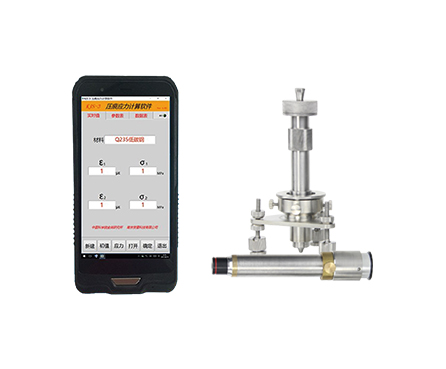
HP-KJS3 is a portable, handheld residual stress measurement system that uses the indentation method to evaluate surface stress quickly on-site. Designed for fast testing and straightforward operation, it supports multi-channel strain acquisition, automatic testing, and real-time stress value/curve display.
| Portable & lightweight | Bring residual stress testing to the part—no need to move large components |
|---|---|
| Fast test workflow | Menu-based touchscreen UI plus automatic test functions for quicker checks |
| Multi-channel flexibility | Scalable input channels help match different test setups |
| Clear data visibility | Real-time stress value + stress curve display supports quick decisions |
| Data ready for reporting | USB communication/storage plus permanent data saving options |
| Built-in processing | Converts strain readings into stress values for direct engineering use |
Handheld & lightweight design for field or shop-floor residual stress checks
ARM-based controller with an embedded operating environment
5-inch touchscreen (menu-driven UI) for simple operation and fast setup
USB port for communication, data export, and storage
Built-in automation: automatic testing, on-screen results, data saving, and post-processing
Strain-to-stress conversion supported (processes measured strain into stress values)
Recommended material hardness: mainly for materials below HRC 50
Stated measurement deviation: 15–20 MPa (application-dependent)
The HP-KJS3 measures residual stress by creating a controlled indentation and capturing the resulting strain response (including a built-in 3-point strain rosette workflow). The instrument then processes the strain data and converts it into stress values, providing real-time stress readings and stress curves on the handheld display, with the option to store data for traceability and reporting.
Residual stress spot-checks after welding, machining, forming, heat treatment, or surface treatment
On-site quality verification for maintenance, process validation, and incoming inspection
Stress trend comparison across batches or process parameters
Suitable for cases where the tested material hardness is < HRC 50
Input channels: configurable 10 to 100 channels
Sampling rate: 10 Hz per channel
Input range: ±30,000 με (microstrain)
Resolution: 0.1 με
Built-in 3-point strain rosette workflow with automated test and processing
USB interface for data transfer/storage
Channels: 10–100 (optional)
Sampling: 10 Hz / channel
Strain range: ±30,000 με
Resolution: 0.1 με
Measurement error: ≤ ±0.1%
Stress error: ≤ 10 MPa
Indenter head diameter: 1.58 mm
Indentation diameter: 1.0–1.2 mm
Indentation depth: 0.15–0.2 mm
Data handling: real-time stress value & curve display, permanent data storage, handheld touchscreen operation
1) What method does HP-KJS3 use to measure residual stress?
It uses the indentation method, measuring strain response from a controlled indentation and converting strain to stress via built-in data processing.
2) Is it suitable for very hard materials?
It’s mainly intended for materials with hardness below HRC 50 (as stated in the product notes).
3) Can I view trends or curves, not just a single value?
Yes. It supports real-time stress value display and stress curve display, plus permanent data storage.
4) How do I export test data?
Via the USB port, which supports communication and data storage/export.
5) How many sensors/channels can it support?
It supports 10–100 input channels depending on configuration.
6) What strain range can it measure?
Up to ±30,000 με, with 0.1 με resolution.
7) What’s the stress accuracy?
The spec lists stress error ≤ 10 MPa, and the product notes also mention a 15–20 MPa maximum measurement deviation (application-dependent).
8) Does it automate the test process?
Yes—automatic testing, on-screen display, data saving, and data processing (strain-to-stress conversion) are included.