
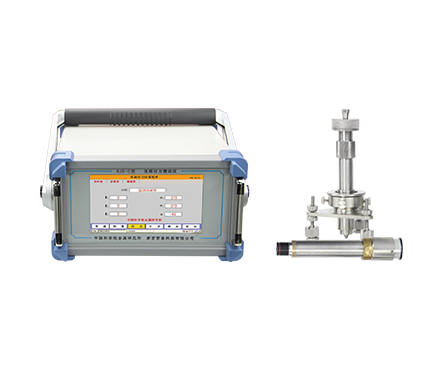
HP-KJS2 is a compact benchtop indentation-method residual stress testing system designed for fast, repeatable surface residual stress evaluation using strain-based measurement and built-in stress calculation. With a 7-inch touch screen, USB data storage, and automatic test workflow, it’s a practical choice for shop-floor QC and lab verification—especially for materials with hardness below HRC50.
| Fast Testing | Touch-screen guided workflow for quick setup and measurement. |
|---|---|
| Compact Design | Small footprint and lightweight build for easy bench deployment. |
| Built-in Calculation | Converts measured strain values into stress values automatically. |
| Clear Operation | Simple menu interface reduces training time and operator errors. |
| Data Traceability | On-screen results + storage and export via USB for reporting. |
| Automation Ready | Supports 3-point strain auto-zero and automatic testing to improve repeatability. |
System type: Benchtop (desktop) residual stress tester (indentation method)
Controller: ARM mainboard
OS: Embedded Windows CE (WinCE)
UI: LCD touch-screen menu (simple, clear operation)
Data & communication: External USB for communication and storage
Automation: 3-point strain auto-zero, automatic test, on-screen display, storage, and data processing (strain → stress)
The HP-KJS2 uses an indentation-based approach combined with multi-channel strain input to support rapid residual stress checks. The system integrates measurement, calculation, display, and storage in one unit—helping engineers reduce manual steps and speed up inspection cycles.
Designed to be small, lightweight, and easy to operate, HP-KJS2 is suitable when you need an efficient residual stress measurement workflow without complex PC setup.
Residual stress checks after machining, grinding, or forming
Process validation for heat treatment effects
Comparative testing for welding or repair work (surface evaluation workflows)
Production quality control in metal parts, fixtures, industrial components
Lab and shop-floor verification for materials below HRC50
Input channels: 4-channel input for strain-based signals
Strain range: ±30000 µε (microstrain)
Resolution: 0.1 µε
Sampling rate: 10 Hz per channel
Measurement functions: 3-point strain auto-zero, automatic testing, data display/storage, strain-to-stress processing
Data interface: USB communication & storage support
| Item | Specification |
|---|---|
| Input Channels | 4 channels |
| Sampling Rate | 10 Hz / channel |
| Input Range | ±30000 µε |
| Resolution | 0.1 µε |
| Measurement Error | ≤ ±0.1% |
| Stress Error | ≤ 10 MPa |
| Indenter Diameter | 1.58 mm |
| Indentation Diameter | 1.0–1.2 mm |
| Indentation Depth | 0.15–0.2 mm |
| Data Processing | WinCE system, 7-inch touch screen, built-in stress calculation/display/storage |
Notes (from product info):
Typical maximum measurement deviation: 15–20 MPa
Recommended for materials with hardness < HRC50
1) What does “indentation method” mean for residual stress testing?
It’s a practical approach that uses a controlled indentation and strain-based response, with the instrument converting strain signals into stress values for evaluation.
2) What materials are suitable for HP-KJS2?
It’s mainly intended for materials with hardness below HRC50 (per the provided product spec).
3) What accuracy can I expect?
The system specifies stress error ≤ 10 MPa, and typical maximum measurement deviation is noted as 15–20 MPa (application-dependent).
4) Does it require a PC?
No. It runs on an embedded WinCE system with a built-in 7-inch touch screen.
5) How do I save and export test data?
Results can be displayed and stored in the device, and exported via USB.
6) How many strain inputs can I run at once?
HP-KJS2 supports 4 input channels.
7) What is “3-point strain auto-zero”?
It’s an automatic zeroing function to help reduce offset and improve repeatability before measurement.
8) What are the indentation dimensions used by this system?
Typical indentation diameter 1.0–1.2 mm, depth 0.15–0.2 mm, with 1.58 mm indenter diameter.