
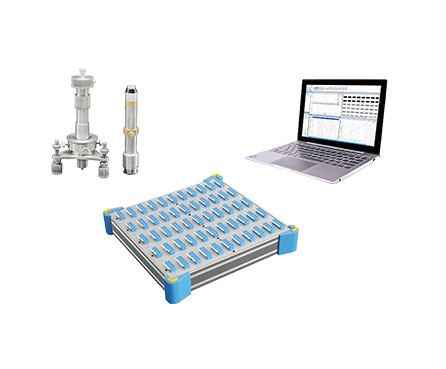
HP-KJS1 is a compact, multi-channel residual stress measurement system based on the indentation method. Built on an ARM platform with an embedded Windows CE OS, it supports fast testing workflows, on-screen data display, USB communication/storage, and PC-based calculation and reporting.
| Compact & portable | Small footprint and lightweight design for lab or field use |
|---|---|
| Fast test workflow | Automatic testing + simple touch menu reduces setup time |
| Multi-channel scalability | Choose 10–100 input channels for multi-point measurement |
| Clear data handling | On-screen display + storage + USB export for traceability |
| Reliable measurement | Fine resolution and defined stress error spec for engineering use |
Product name: HP-KJS1 (Multi-Channel) Indentation Residual Stress Testing System
Core function: Converts measured strain signals into residual stress results through data processing
Control & UI: LCD touch-screen menu for quick operation
Connectivity: External USB port for data communication and storage
Automation: Built-in 3-point strain auto-zeroing and automatic testing
Best-fit materials: Primarily for applications where material hardness < HRC50
HP-KJS1 is designed for engineers who need reliable residual stress testing with flexible channel expansion (10–100 channels optional). The system focuses on efficiency: guided touch UI, automatic test routines, real-time display and storage, and PC-based processing to compute and present residual stress values from strain measurements.
Residual stress inspection for manufacturing quality control
Stress evaluation after welding, machining, forming, heat treatment
Process validation and comparison testing in R&D labs
Multi-point residual stress mapping for components and assemblies
Materials testing where hardness is below HRC50
Multi-channel strain signal acquisition (10–100 channels optional)
Supports strain input range up to ±30000 με with 0.1 με resolution
Built-in 3-point strain auto-zeroing and automated measurement workflow
USB interface for PC communication and data export/storage
PC-based processing for calculation, storage, and result display
Input Channels: 10–100 channels (optional)
Sampling Rate: 10 Hz / channel
Input Range: ±30000 με
Resolution: 0.1 με
Measurement Error: ≤ ±0.1%
Stress Error: ≤ 10 MPa
Indenter Diameter: 1.58 mm
Indentation Size: Indent diameter 1.0–1.2 mm
Indentation Depth: 0.15–0.2 mm
Data Processing: Calculation, storage, and display via PC
Q1: What is the HP-KJS1 used for?
A: It’s used to measure residual stress using the indentation method, acquiring strain signals and converting them into stress results through data processing.
Q2: How many measurement points can I run at once?
A: The system supports 10–100 channels optional, so you can scale from small tests to multi-point measurement.
Q3: Is the operation complicated?
A: No. It uses an LCD touch screen with a simple menu and supports automatic testing.
Q4: How do I export or store the data?
A: Use the USB port for communication and storage, and process/report data on a PC.
Q5: What types of materials are best suited?
A: It’s mainly intended for cases where material hardness is below HRC50.
Q6: What accuracy can I expect?
A: Key specs include ≤ ±0.1% measurement error and ≤ 10 MPa stress error (actual performance depends on test setup and material condition).
Q7: Does it support automated zeroing?
A: Yes—there is 3-point strain auto-zeroing built in.