
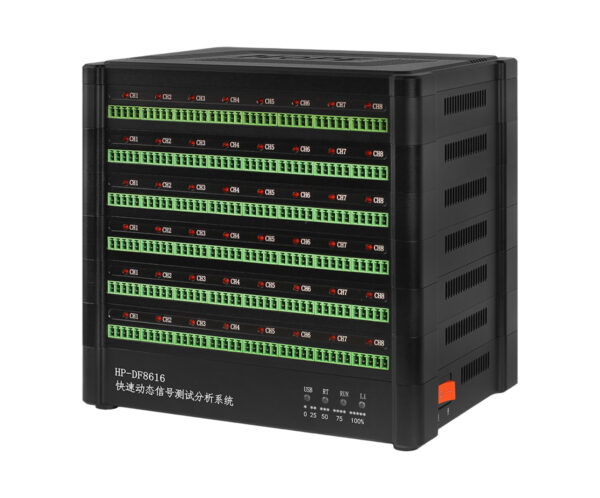
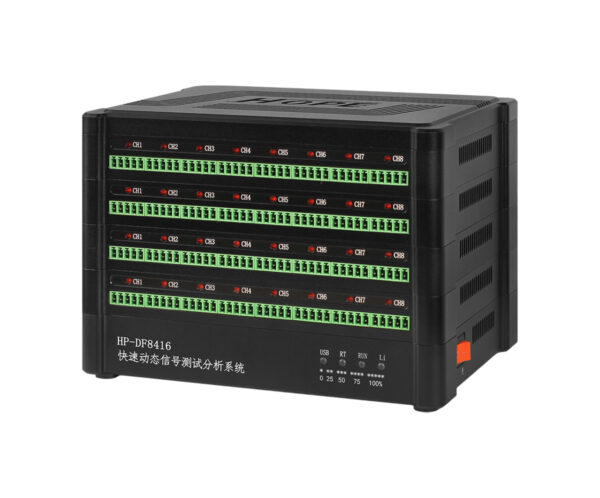


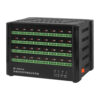
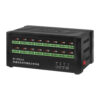
HP-DF is a fast dynamic data acquisition system (DAQ) with synchronized parallel sampling up to 1 MHz, supporting DC/AC/IEPE/strain inputs, 8–48 channels per unit, 18-bit high-speed ADC, 16-bit DAC auto-balance, and built-in excitation for vibration, shock, and multi-sensor testing.
| Universal mixed inputs | Each channel can be configured for DC, AC, IEPE, or strain analog input types—no extra signal modules needed for true “universal input”. |
|---|---|
| Per-channel auto-balance (zeroing) | Built-in 16-bit DAC per channel enables full-range hardware auto-balance, and software allows manual zero-point adjustment. |
| High-speed synchronized sampling | Each channel uses an 18-bit high-speed ADC. All channels perform parallel, synchronized sampling, display, and storage up to 1 MHz max. |
| High-accuracy signal conditioning | High-precision front-end bridge circuits, stable amplification/conditioning, and high-performance ADC deliver up to 0.2% test accuracy. |
| Built-in excitation options | Built-in high-capacity lithium battery options and multiple excitation outputs: 0–10 V, +24 V, ±12 V constant-voltage, plus 24 V / 4 mA constant-current excitation for sensor powering. |
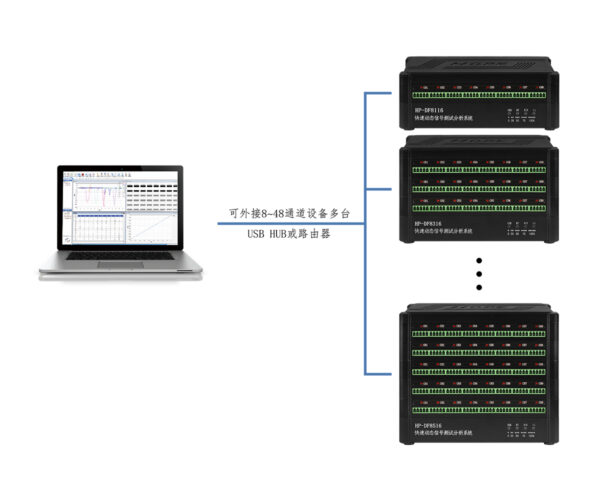
| Expandable channel architecture | 8–48 channels per unit, and multiple units can be networked to scale up for large test systems. |
HP-DF is a fast dynamic signal test and analysis DAQ designed for high-speed, multi-channel, synchronous acquisition in lab and field testing. It supports DC/AC/IEPE/strain inputs and a wide range of sensor types (strain, voltage, current, temperature, displacement, acceleration, speed, and more). With parallel synchronized sampling up to 1 MHz, per-channel hardware auto-balance, and built-in excitation, HP-DF is ideal for vibration testing, shock testing, transient capture, and multi-point structural measurements where timing alignment across channels is critical.
Strain (bridge): ±3000 to ±1,000,000 με
Voltage (AC/DC): ±5 mV to ±10 V
Current: ±20 mA, 0–20 mA, 4–20 mA
Temperature: RTD, thermocouple, thermistor
Displacement: strain-type, resistive, inductive, eddy-current, laser displacement sensors
Acceleration / Speed: electromagnetic, capacitive, IEPE, charge-type sensors
Other: resistance, frequency, and other analog sensor outputs
Parameter — Specification
Measurement points: 8–48 channels per unit; multi-unit expansion supported
Sampling rate: 1 Hz to 1 MHz per channel; all channels synchronized parallel acquisition
ADC resolution: 18-bit
Measurement types:
Strain: ±3000 to ±1,000,000 με
Voltage (AC/DC): ±5 mV to ±10 V
Current: ±20 mA / 0–20 mA / 4–20 mA
Temperature: RTD / thermocouple / thermistor
Displacement: strain / resistive / inductive / eddy-current / laser displacement
Acceleration & speed: electromagnetic / capacitive / IEPE / charge
Others: resistance / frequency, etc.
Bridge configurations: full bridge, half bridge, 1/4 bridge (2-wire), 1/4 bridge (3-wire), 1/4 bridge compensation bridge
Excitation power:
Front-end: 0–10 V / 240 mA, accuracy 0.1%
Back-end: built-in IEPE 4 mA constant-current source and conditioning circuit
Trigger modes: free trigger, internal trigger, external trigger
Measurement accuracy: 0.2% ± 2 bytes
Auto-balance: per-channel independent 16-bit DAC full-range hardware auto-balance; software manual zero supported
Embedded system: embedded system
Communication interfaces: USB, Ethernet
Power supply: AC 220 V / 50 Hz, DC 12 V, optional lithium battery
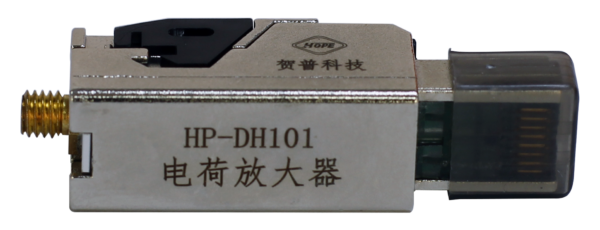
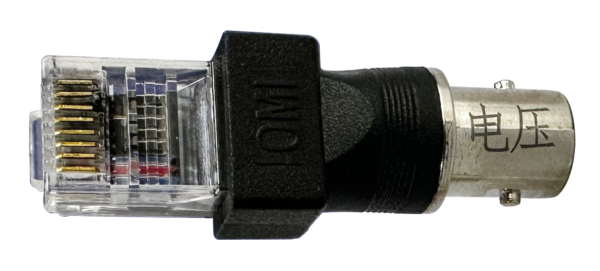
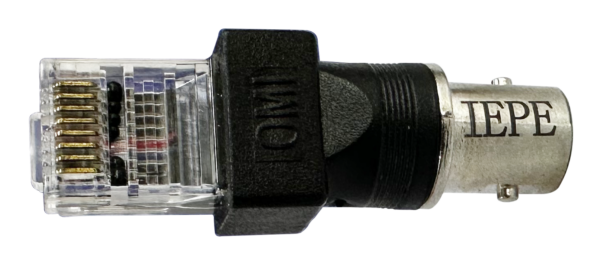
Optional accessories: Ethernet-to-IEPE adapter (optional), Ethernet-to-voltage adapter (optional), charge amplifier (optional)
Q1: What makes HP-DF suitable for fast dynamic testing?
HP-DF provides parallel synchronized sampling up to 1 MHz, so all channels capture transient events at the same time reference—critical for vibration, shock, and multi-point dynamic tests.
Q2: Does HP-DF support IEPE sensors for vibration testing?
Yes. HP-DF supports IEPE inputs and includes a built-in 4 mA constant-current IEPE source with conditioning.
Q3: Can I scale beyond 48 channels?
Yes. HP-DF supports multi-unit expansion, allowing larger channel-count systems through networking and synchronized acquisition.