
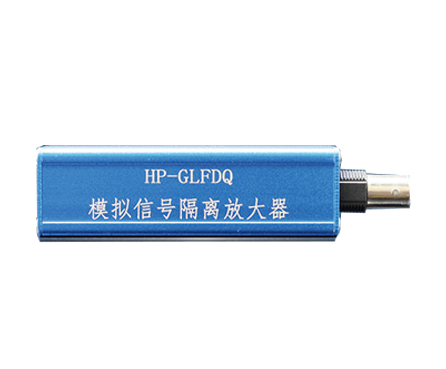
The HP-GLFDQ Analog Signal Isolation Amplifier is a compact, low-loss module designed to amplify and galvanically isolate analog signals for stable, noise-resistant measurement and control. It integrates an internal signal conditioning amplifier and a linear opto-isolation circuit to reduce signal attenuation and protect instrumentation—ideal for thermocouple, micro-voltage, and general analog sensor outputs, and for use with HP-D series dynamic test systems.
| Galvanic isolation up to 4000 V | Helps protect DAQ/analyzers and reduces ground-loop problems |
|---|---|
| Low signal attenuation design | Internal amplifier + linear optical isolation circuit reduces transmission loss |
| Wide input range coverage | Supports micro-voltage through standard voltage signals |
| Stable isolated output | Standard voltage output with strong anti-interference performance |
| Thermocouple-friendly | Supports thermocouple signal conditioning (0–1500°C range indicated) |
| Compact form factor | Easy to deploy in field test rigs and control cabinets |
Product Series: HP-GLFDQ
Product Type: Analog signal isolation amplifier / galvanic isolator
Channels: 1-channel analog input with isolated output
Core Function: Signal amplification + electrical isolation to suppress interference and prevent ground-loop issues
Designed For: Thermocouple signals, micro-voltage signals, and other analog voltage sensor outputs
System Integration: Compatible with HOPE HP-D series dynamic testing systems (as described)
In industrial measurement and test environments, analog signals are often affected by ground loops, common-mode noise, and high interference, leading to unstable readings or even instrument damage. HP-GLFDQ provides high-voltage isolation (4 kV) while maintaining accurate analog transmission. With multiple input ranges—from ±10 mV up to ±10 V—it supports both low-level sensor signals and standard voltage outputs, enabling cleaner acquisition and safer system integration.
Thermocouple measurement isolation in noisy industrial environments
Micro-voltage signal isolation for precision sensing and testing
Analog sensor signal conditioning before DAQ/dynamic analyzers
Ground-loop elimination in distributed measurement systems
Protection and signal isolation for dynamic testing and industrial monitoring setups
Test benches exposed to strong electromagnetic interference or high-voltage environments
Analog input: 1 channel
Supported signal types (examples from spec):
Thermocouple signals (temperature range: 0–1500°C)
Micro-voltage analog signals (mV level)
Standard analog voltage sensor outputs (V level)
Compatible systems: HOPE HP-D series dynamic test systems (per product description)
(From the provided table)
Analog Input: 1 channel
Isolated Output: Standard voltage output, full-range ±5 V or ±10 V
Analog Input Ranges (selectable):
±10 mV, ±50 mV, ±100 mV, ±500 mV, ±1 V, ±5 V, ±10 V
Temperature (Thermocouple): 0–1500°C
Excitation Output: ±12 V
System Uncertainty: ≤ ±3 mV
Isolation Voltage: 4000 V
Operating Condition: Works normally under strong electric-field / plasma (or strong interference) environments (as stated)
1) What is an analog isolation amplifier used for?
It isolates and conditions analog signals to reduce noise, ground loops, and interference, improving measurement stability and protecting instruments.
2) Can HP-GLFDQ handle very small signals like millivolts?
Yes. It supports input ranges as low as ±10 mV, making it suitable for micro-voltage measurement scenarios.
3) What output does the module provide?
It provides a standard isolated voltage output, with full-scale options ±5 V or ±10 V.
4) Is it suitable for thermocouples?
Yes. The specification indicates thermocouple support with a temperature range of 0–1500°C (system integration depends on your thermocouple type and wiring).
5) How much isolation does it provide?
The isolation voltage is 4000 V, helping protect downstream DAQ/analyzers and reduce common-mode interference.