
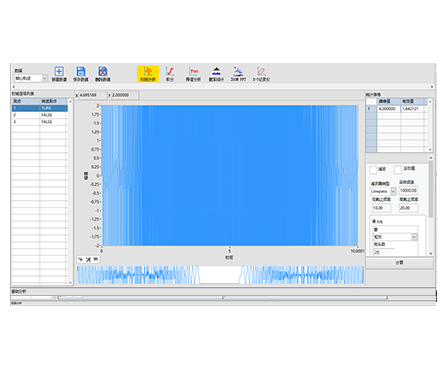
HP-STAP Filter Analysis Software helps engineers quickly build and apply digital filters for signal conditioning and analysis. It supports low-pass, high-pass, band-pass, and band-stop filtering, with flexible configuration for cutoff frequency and filter order, plus both FIR and IIR filter design options.
| Complete filter set | Low-pass, high-pass, band-pass, and band-stop filters in one module |
|---|---|
| Simple, engineer-friendly setup | Configure cutoff frequency and filter order directly |
| FIR & IIR support | Choose FIR for linear-phase style workflows, or IIR for efficient classic designs (application-dependent) |
| Classic IIR filter options | Includes Butterworth, Chebyshev, Inverse Chebyshev, Elliptic, and Bessel for different response needs |
| Better analysis quality | Clean signals improve the reliability of spectrum and diagnostic results |
Series: HP-STAP
Product Type: Filter analysis / digital filter design software
Filter Modes: Low-pass, High-pass, Band-pass, Band-stop (notch)
Filter Families: FIR and IIR (selectable)
Key Controls: Cutoff frequency + filter order
IIR Types Supported: Butterworth, Chebyshev, Inverse Chebyshev, Elliptic, Bessel
In real-world measurement and vibration/noise testing, signals often include unwanted frequency components—background noise, electrical interference, or irrelevant bands. HP-STAP provides a practical filtering toolkit so you can isolate the frequency range that matters, improve signal clarity, and prepare data for downstream analysis (FFT, time-frequency, order analysis, etc.).
Pre-processing vibration signals before FFT / envelope / time-frequency analysis
Removing low-frequency drift or high-frequency noise in sensor outputs
Notch/band-stop filtering to suppress narrow-band interference
Band-pass filtering to isolate fault-related frequency zones in machinery diagnostics
Signal conditioning for R&D tests, QA validation, and condition monitoring workflows
(Kept general to avoid adding specs not shown in the image.)
Works with time-domain signals from common measurement sources used in testing and monitoring (e.g., vibration/acoustic/analog sensor signals)
Suitable as a pre-processing step before analysis modules inside the HP-STAP workflow
(Based strictly on the image’s feature list—no invented numeric ranges.)
Filter type selection: low-pass / high-pass / band-pass / band-stop
Cutoff frequency setting: configurable per selected filter type
Filter order setting: configurable per filter
FIR mode: set number of taps (tap count / coefficients per delay)
IIR mode: select IIR family + set order
Butterworth
Chebyshev
Inverse Chebyshev
Elliptic
Bessel
Q1: What is the difference between FIR and IIR filters?
FIR (Finite Impulse Response) and IIR (Infinite Impulse Response) are two common digital filter structures. HP-STAP lets you choose either one depending on your filtering goals and signal characteristics.
Q2: What filter types are available?
You can create low-pass, high-pass, band-pass, and band-stop filters, then set cutoff frequency and order.
Q3: What does “taps” mean in FIR filtering?
In FIR mode, you can set the number of taps, which relates to how many delayed samples are used and the associated coefficients applied to them.
Q4: Which IIR filter families are included?
HP-STAP supports classic IIR designs: Butterworth, Chebyshev, Inverse Chebyshev, Elliptic, and Bessel.
Q5: When should I use band-stop (notch) filtering?
Band-stop filters are commonly used to suppress a specific unwanted frequency band (for example, interference) while preserving the rest of the signal.