
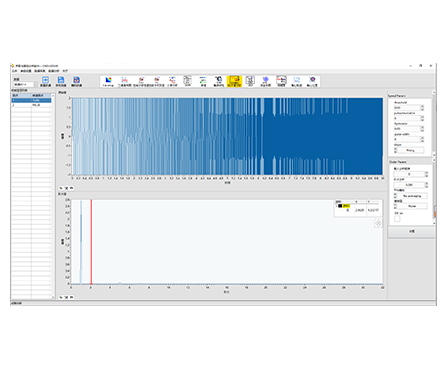
HP-STAP Order Analysis Software is designed for precise order tracking under changing speed. With speed-synchronous sampling, it delivers reliable order results during rapid acceleration, rapid deceleration, or when orders are dense, where a standard FFT can become hard to interpret.
| Accurate order tracking at changing speed | Speed-synchronous sampling improves stability during run-up/coast-down |
|---|---|
| Handles challenging transients | Suitable for rapid acceleration/deceleration conditions |
| Clear visualization for dense orders | Waterfall, colormap, and 3D views help separate closely spaced components |
| Faster fault isolation | Makes it easier to distinguish speed-related issues from fixed-frequency disturbances |
Series: HP-STAP
Product Type: Order analysis / order tracking software
Core Capability: Speed-synchronous sampling for accurate order tracking
Best For: Run-up / coast-down tests, variable-speed machines, dense order conditions
Result Displays: Waterfall spectrum, Colormap, and 3D waterfall plots
Order analysis converts frequency content into orders tied to rotational speed, helping you see vibration components that scale with RPM. HP-STAP adds speed-synchronous sampling to keep order tracking stable when speed changes quickly—making it easier to diagnose rotating machinery behavior during transient operating conditions.
Motors, pumps, fans, compressors under variable-speed operation
Gearbox and rotating assembly diagnostics during start/stop
NVH and rotating machinery testing with RPM sweeps
Detecting imbalance, misalignment, looseness, and speed-related resonance behaviors
Any scenario where orders cluster tightly and need clearer separation
(Kept general—exact channel types depend on your DAQ configuration.)
Supports analysis of time-domain signals commonly used in condition monitoring (e.g., vibration signals)
Requires a speed reference for speed-synchronous sampling (e.g., tachometer/encoder-type RPM reference, depending on your setup)
(Typical order-analysis controls; exact options depend on your software build.)
Speed-synchronous sampling for order tracking
Order tracking analysis optimized for variable-speed conditions
Visualization modes: Waterfall spectrum, Colormap, 3D waterfall plot
Analysis setup: selectable order range / resolution settings (per method)
Reporting-ready views: plots suitable for test documentation and diagnostics
Q1: What is order analysis (order tracking)?
Order analysis expresses vibration components as orders linked to rotational speed, which is ideal for rotating machinery where key components scale with RPM.
Q2: Why do I need speed-synchronous sampling?
When speed changes quickly, standard spectral views can smear or blur. Speed-synchronous sampling improves tracking accuracy during rapid acceleration/deceleration and transient tests.
Q3: When is order analysis most useful?
It’s especially useful for run-up/coast-down, variable-speed drives, and cases where multiple speed-related components overlap in the frequency domain.
Q4: What display formats are available?
HP-STAP supports waterfall spectrum, Colormap, and 3D waterfall displays for clearer interpretation of order behavior over time/speed.
Q5: Do I need an RPM signal?
Yes. Order tracking relies on a speed reference signal so the software can align data to rotational speed accurately.