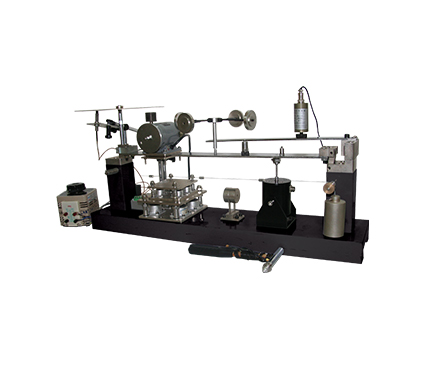
The HP-VCES Series is a modular vibration and control simulation teaching lab platform designed to recreate real engineering vibration phenomena in a classroom/lab setting. It combines multiple test structures, excitation sources, a vibration control chain, and an 8-channel dynamic DAQ, so students can learn structural dynamics, vibration measurement, and closed-loop vibration control through hands-on experiments.
| Realistic vibration simulation | Reproduces common engineering vibration behaviors for near real-world lab training. |
|---|---|
| Integrated monitoring & control | Supports real-time observation and control workflows typical of vibration control testing. |
| Modular teaching architecture | Easy to reconfigure experiments for different courses (structural dynamics, vibration, control). |
| High interactivity | Students can adjust test parameters via software/hardware and directly observe response changes. |
| Complete measurement chain | From excitation → sensors → DAQ → analysis, aligned with vibration measurement practice. |
Product line: HP-VCES Series
Product name: Vibration & Control Simulation Teaching Experiment Platform
Core idea: Simulate real vibration environments and teach measurement + control with interactive operation (software/hardware parameter tuning).
Design highlights: Modular configuration for different teaching goals; integrated monitoring/control capability.
This platform supports a complete learning loop:
Build a structural model (beam/plate/multi-DOF)
Excite the structure (impact, eccentric excitation, contact/non-contact excitation)
Measure response (acceleration/velocity/displacement, force input)
Acquire & analyze data (dynamic DAQ, modal/vibration metrics)
Apply control/isolation/absorption modules to observe response changes and validate concepts.
University / college labs: Mechanical engineering, mechatronics, structural dynamics, control engineering
Vocational & training centers: Vibration testing basics, sensor usage, DAQ practice
Teaching demonstrations: Resonance, damping, frequency response, vibration isolation
Lab method training: Impact testing, excitation methods comparison, response measurement
Included sensor and measurement support (per system configuration list):
Accelerometers: 8 units (for multi-point response measurement)
Velocity sensor: 1 set
Displacement sensor: 1 set
Force measurement: Instrumented impact hammer with force sensor
Dynamic DAQ: DC8125 8-channel dynamic data acquisition system
Supports common vibration signal types used in labs (force input + acceleration/velocity/displacement response).
(Only parameters explicitly shown in the provided product info are listed below.)
Test structures (test rig options):
Simply supported beam rig
Cantilever beam rig
Circular plate rig
Multi-degree-of-freedom (MDOF) system rig
Excitation modules:
Impact hammer (with force sensor)
Eccentric excitation system (eccentric motor + voltage regulator)
Contact exciter
Non-contact exciter
Vibration control chain:
Digital signal generator
Power amplifier
Real-time controller
Isolation & absorption modules:
Active isolator
Passive isolator
Single / dual dynamic vibration absorber
Accessories:
Magnetic bases: 2 units
Data acquisition:
DC8125 dynamic DAQ: 8 channels
Q1: What can students learn with the HP-VCES platform?
A: Core lab skills in vibration measurement (sensor selection/installation, signal capture), structural response observation, and the basic workflow of vibration control testing (monitoring, control chain understanding).
Q2: What excitation methods are available?
A: Impact excitation (instrumented hammer), eccentric motor excitation, plus contact and non-contact excitation options—useful for comparing different input methods.
Q3: Does it support multi-point measurement?
A: Yes. The configuration includes 8 accelerometers and an 8-channel dynamic DAQ, which supports multi-location response measurement.
Q4: Can the platform be adapted for different courses?
A: Yes. The system is modular: you can select different structures (beam/plate/MDOF), excitation sources, and isolation/absorber modules to match course objectives.
Q5: Is it suitable for demonstrating vibration isolation concepts?
A: Yes. It includes both active and passive isolators and vibration absorbers for comparison and teaching demonstrations.