
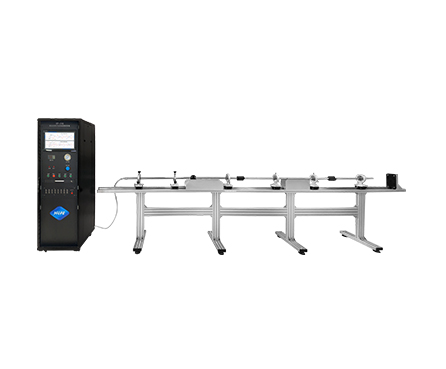
The HP-JSG Series Hopkinson Pressure Bar Testing System (also known as a Split Hopkinson Pressure Bar / SHPB / Kolsky bar system) is built for high strain-rate tensile and compression testing with clear stress-wave capture and automated data processing. With 16-bit high-precision acquisition, PLC-based control, and optional high-temperature coupled loading, it supports reliable dynamic material characterization for research and industrial labs.
| High-precision waveform capture | 16-bit data acquisition clearly displays incident/reflected/transmitted waves for accurate SHPB analysis. |
|---|---|
| Fully automatic calculation | Automatic recognition of key waveforms and result computation reduces manual processing time. |
| Single-loading stress wave control | PLC + pressure sensor + regulator/valves enable one-time stress-wave loading to reduce errors from repeated incident loading. |
| Fast test cycle | Automatic projectile return resets the system after each impact for the next shot. |
| Coaxiality verification | Easier alignment of the specimen and waveform-based checks improve repeatability. |
| Adjustable incident pulse | Tune projectile speed/shape to shape the incident pulse and control specimen loading behavior. |
System type: Hopkinson Pressure Bar / SHPB high strain-rate testing system
Waveform visibility: Clear display of incident, reflected, transmitted, and dispersive waveforms
Automation: Auto-identifies key waves and computes results automatically
Loading control: Single stress-wave loading via PLC + pressure/valve control to reduce test errors from repeated incident loading
Convenience & repeatability: Adjustable pressure + automatic projectile return for fast test cycles
Alignment support: Easy specimen coaxiality adjustment and waveform-based verification
Pulse shaping / control: Adjust projectile impact speed and geometry to tune the incident pulse waveform
Hopkinson pressure bar systems are widely used to obtain material stress–strain response under high strain rates, by analyzing stress waves traveling through elastic bars.
The HP-JSG Series integrates control + data acquisition + data processing into one platform and can generate test reports quickly. It also supports high-temperature coupled high strain-rate testing to study dynamic behavior under thermal-mechanical conditions.
Dynamic compression testing of metals, alloys, ceramics, composites, and rocks
High strain-rate tensile testing (dynamic tension configurations)
Constitutive model calibration (e.g., crash/impact material parameters)
Impact/ballistic-related materials research and energy-absorption studies
High-temperature + high strain-rate coupled tests for hot deformation research
Control & loading components: PLC control, pressure sensor, pressure regulator, solenoid valves, needle valves (for stable pneumatic loading and shot control)
Data acquisition: 16-bit high-resolution DAQ for stress-wave signals (incident/reflected/transmitted)
Projectile monitoring: Real-time display of projectile mass, velocity, and energy
Integrated workflow: Control system + DAQ + processing system with one-click report generation
Loading method: Pneumatic loading
Loading pressure range: 0–1 MPa
Impact speed: 0–40 m/s
Strain-rate range: 500–8000 s⁻¹
High-temperature coupling range: 0–1100 °C
Engineering strain range: 0–50%
Stress-wave amplitude repeatability: >95%
Standard bar diameter: 12–36 mm
Max specimen diameter: 12–36 mm
Projectile mass: 5–100 g
Integrated functions: Control + acquisition + processing; one-click report output
High-temperature coupling: Synchronous high-temperature loading for high strain-rate + high-temp tests
Projectile return: Automatic reset after each impact
Standards referenced
GB/T 30069.1-2013 (high strain-rate tensile test for metallic materials)
GJB 5365-2005 (dynamic compression test method for metallic materials)
JJG 623-2005 (verification regulation for resistance strain instruments)
1) What is a Hopkinson pressure bar (SHPB) system used for?
It is used to measure dynamic stress–strain response of materials under high strain-rate loading by analyzing incident/reflected/transmitted stress waves.
2) What strain rates can the HP-JSG Series achieve?
Typical strain-rate capability is 500–8000 s⁻¹ (depending on specimen and setup).
3) Can it perform high-temperature SHPB tests?
Yes. The system supports high-temperature coupled loading up to 1100 °C for thermo-mechanical dynamic testing.
4) How does the system reduce test error from repeated loading?
It uses PLC + pressure sensing + valve components to achieve one-time stress-wave loading, helping avoid errors from repeated incident wave loading.
5) What specimen sizes are supported?
Max specimen diameter is 12–36 mm (matching the standard bar diameter range).
6) How are reports generated?
The system integrates control + acquisition + processing and supports one-click test report generation.