
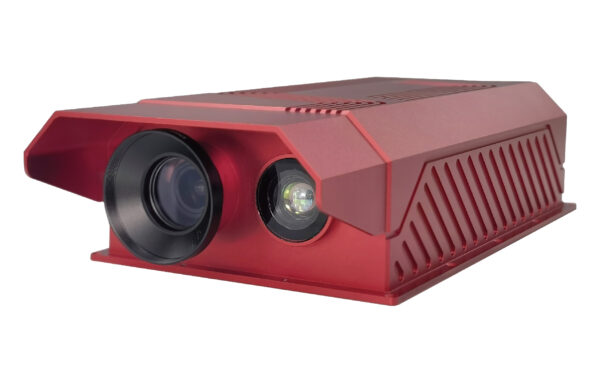
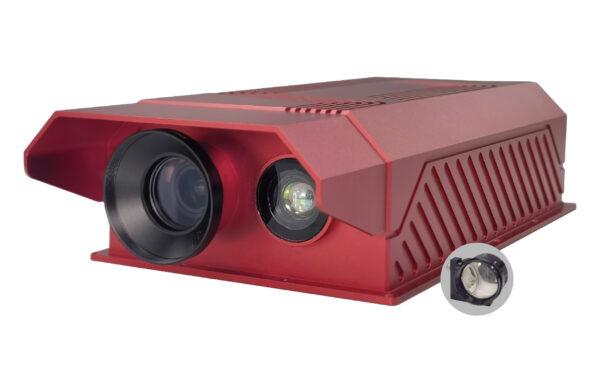
HP-VPD3 is a long-distance, non-contact displacement/deflection measurement system based on image-measurement algorithms. Built on an embedded platform with a low-light CMOS image sensor, it is designed for large-range structural deformation monitoring with high accuracy, compact size, high integration, and easy installation.
| Non-contact measurement | No physical sensor mounting on the measured structure |
|---|---|
| Passive target | Target point does not require power supply |
| Long measurement distance | 5–300 m (lens-dependent), custom distances available |
| High accuracy at range | Up to ±0.1 mm (≤20 m), with graded accuracy over distance |
| Large deformation coverage | 0.01 mm to 300 m displacement range (large deformation) |
| Flexible acquisition modes | Continuous / timed / external-trigger collection |
| Reliable data handling | Local SSD storage + synchronized server upload (dual backup) |
| Easy integration | TCP/UDP/MQTT/Modbus + private protocol customization |
Measurement principle: Vision-based image measurement algorithm (camera + embedded processing)
Target type: Passive target (no power required at the target point)
Measurement capability: 2D deformation at the target (vertical deflection + lateral displacement)
Designed for: Long-range, outdoor/industrial displacement monitoring where wiring to sensors is difficult
HP-VPD3 captures target images using a low-illumination CMOS sensor and calculates displacement through onboard image processing. By selecting lenses with different focal lengths, it supports long measurement distances and wide monitoring coverage. Data can be stored locally with dual backup and transmitted to servers or cloud platforms through multiple communication options.
Bridge deflection monitoring (static & dynamic)
Building/structure lateral displacement and settlement-related deformation observation
Tunnel, dam, and slope deformation monitoring
Crane booms, gantry structures, and large industrial frames
Rail/metro infrastructure displacement monitoring
Wind turbine tower deflection and foundation movement observation
Laboratory or field testing where wired sensors are impractical over long distances
Imaging sensor: Low-light CMOS image sensor (for challenging lighting environments)
Embedded system: Onboard embedded processing (field-deployable)
Multi-point measurement: Supports different point counts with frequency scaling (single point, dual point, 30 points, 100 points; customizable)
Trigger support: Threshold-based camera photo linkage; supports external trigger acquisition
Networking & wireless: Built-in Gigabit Ethernet; optional 4G and Wi-Fi; supports offline operation
Protocols: TCP / UDP / MQTT / Modbus; supports custom/private protocol development
| Item | Specification |
|---|---|
| Measurement distance | 5–300 m (requires different focal-length lenses); custom on request |
| Displacement range | 0.01 mm to 300 m (large deformation) |
| Displacement accuracy | ±0.1 mm (≤20 m); ±0.2 mm (≤50 m); ±0.5 mm (≤100 m); ±1 mm (≤200 m) |
| Field width (coverage) | 14 m (20 m distance); 35 m (50 m); 75 m (100 m); 140 m (200 m) |
| Sampling rate (by points) | 1 point ≤100 Hz; 2 points ≤50 Hz; 30 points ≤20 Hz; 100 points ≤1 Hz; custom point counts available |
| Measurement directions | 2D deformation: vertical deflection + lateral displacement |
| Photo linkage | Set threshold to trigger camera photo capture |
| Work modes | Continuous / timed / external trigger; duration configurable |
| Communication | Gigabit Ethernet + optional 4G/Wi-Fi; offline capable |
| Communication protocols | TCP, UDP, MQTT, Modbus; private protocol customization supported |
| Storage | Local 32 GB SSD + synchronized server transfer; dual backup |
| Software functions | Real-time curves (vertical & lateral), displacement values, real-time image display, cloud platform docking, historical data review, resumable data transfer |
| Power supply (device) | DC 8–36 V |
| Field power option | Optional 60 Ah lithium battery + 100 W solar panel; off-grid continuous operation up to 7 days |
| Passive target | No power required at the target |
Q1: How does HP-VPD3 measure displacement without contact?
A: It uses image-based measurement algorithms: the camera observes a passive target and computes displacement/deflection from image changes.
Q2: Does the target need power or wiring?
A: No. It uses a passive target, so the target point does not require power.
Q3: What affects the measurement distance (5–300 m)?
A: Mainly the lens focal length and site conditions. Different lenses enable different distances; custom distance configurations are available.
Q4: Can it measure both vertical deflection and sideways movement?
A: Yes. It supports 2D deformation measurement: vertical deflection and lateral displacement simultaneously.
Q5: How many points can be monitored at the same time?
A: Point count is configurable. Sampling rate scales with point count (e.g., single point up to 100 Hz; 100 points up to 1 Hz), and other point counts can be customized.
Q6: What if the site has no stable internet?
A: The system supports offline operation and local storage. Data can be synchronized later via Ethernet/4G/Wi-Fi.
Q7: How is data protected?
A: Local SSD storage plus synchronized server transfer provides dual backup, reducing the risk of data loss.