
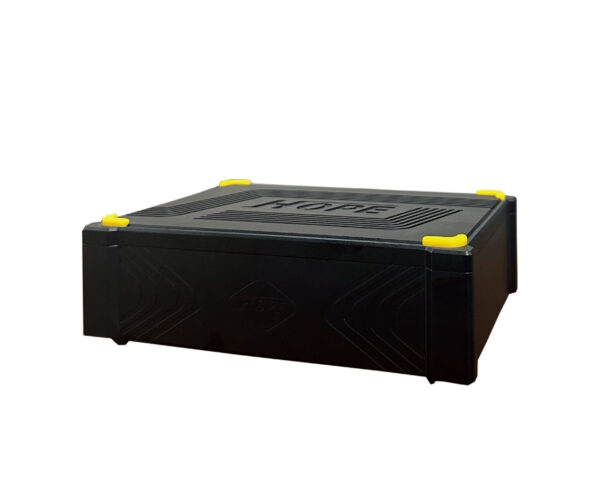
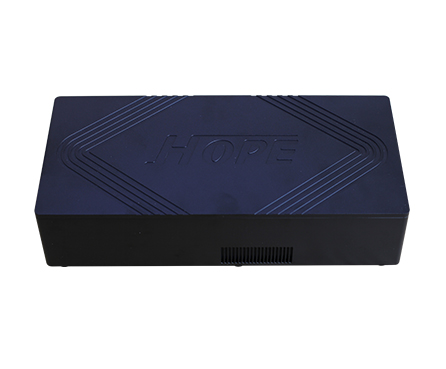
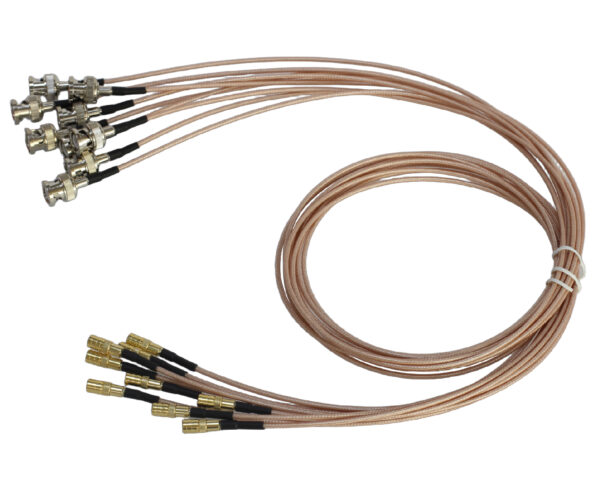
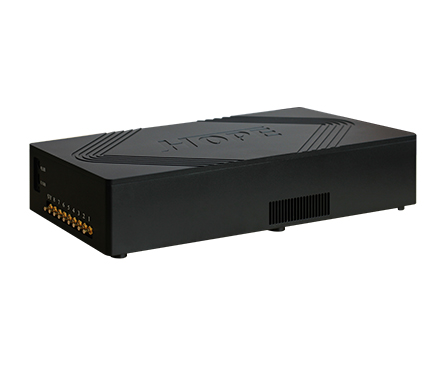
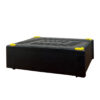
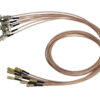
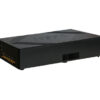
HP-GD8 is an 8-channel ultra-high-speed data acquisition (DAQ) system designed for dynamic signal testing in strong EMI environments. It supports 50–100 MHz synchronous sampling across all channels, real-time display and saving, and high-throughput USB 4.0 data transfer for demanding shock, vibration, temperature, and heat-flux related tests.
| Mixed Inputs for Harsh EMI Environments | In strong electromagnetic interference conditions, each channel can connect to different sensors to measure dynamic physical signals such as dynamic temperature, heat flux density, and vibration acceleration (via sensor voltage outputs). |
|---|---|
| 100 MHz Synchronous Sampling (All Channels) | All measurement points can be sampled, displayed, and saved synchronously. The maximum sampling rate reaches 100 MHz, and the sampling rate can be set freely in software. |
| Built-In Excitation Output | Provides excitation output for field sensor powering. Selectable excitation: 12 V / 24 V (optional). |
| Modular & Lightweight Design | Modular, lightweight structure makes it easy to carry and deploy. The measurement point count can be customized based on the test plan, enabling flexible, “building-block” style configuration. |
| Flexible Power for Field Tests | Supports AC 220V / 50Hz or DC 12V power input, and supports an internal 12.6V lithium battery for 4 hours standalone operation, ideal for outdoor explosive shock tests and field experiments. |
| Item | Specification |
|---|---|
| Input Channels | 8 channels |
| Sampling Rate | 50–100 MHz, all channels synchronous parallel sampling |
| ADC Resolution | 16-bit |
| Accuracy | ±0.2% |
| Signal Bandwidth | 1–50 MHz |
| Measurement Type | Voltage input: ±1 V, ±5 V |
| Excitation Source | +12 V / +24 V optional |
| Interface | USB 4.0, up to 4000 MB/s transfer speed |
| Data Storage | Real-time storage to PC; 100 MHz full-speed continuous acquisition for 5+ minutes |
| Power | AC 220V/50Hz or DC 12V; internal 12.6V Li-battery supported |
| Trigger Modes | Software / internal / external trigger; positive & negative delay; fast edge recognition (high/low level, rising/falling edge) |
| Embedded System | Linux |
Explosion shock & impact testing (field or lab)
High-frequency vibration & acceleration testing
High-speed transient voltage capture
Dynamic temperature / heat-flux experiments (via sensor voltage outputs)
EMI-challenging test sites (power equipment, industrial sites, high-interference areas)
HP-GD8 main unit (8-channel)
USB 4.0 high-speed connection to PC (for real-time data storage)
Power options: AC 220V or DC 12V; internal battery option for field operation
100 MHz is the maximum sampling rate. The system bandwidth is 1–50 MHz, which is the effective frequency range for accurate signal capture.
Yes. HP-GD8 supports synchronous parallel sampling across all channels, with synchronized display and saving.
The voltage input ranges are ±1 V and ±5 V (selectable). Many sensors (accelerometers, heat-flux sensors, temperature transmitters, etc.) can be used via their conditioned voltage outputs.
Yes. The system is designed for strong EMI environments, supporting stable dynamic signal acquisition where conventional devices may show noise or triggering errors.
HP-GD8 supports software trigger, internal trigger, and external trigger, plus positive/negative delay modes. It can quickly recognize level triggers and edge triggers (rising/falling).
Data is stored in real time to a connected PC via USB 4.0. At full-speed 100 MHz acquisition, continuous recording is 5 minutes or longer (depends on PC performance and storage speed).
Yes. It provides excitation output. 12 V / 24 V options are available for powering compatible sensors or front-end modules.
It supports AC 220V/50Hz or DC 12V, and an internal 12.6V lithium battery for about 4 hours standalone operation, which is useful for outdoor tests.
An embedded Linux system is used for stable acquisition and control.
Most buyers search for 100 MHz DAQ, high-speed data acquisition, USB4 data acquisition, dynamic signal acquisition, or transient recorder solutions.