
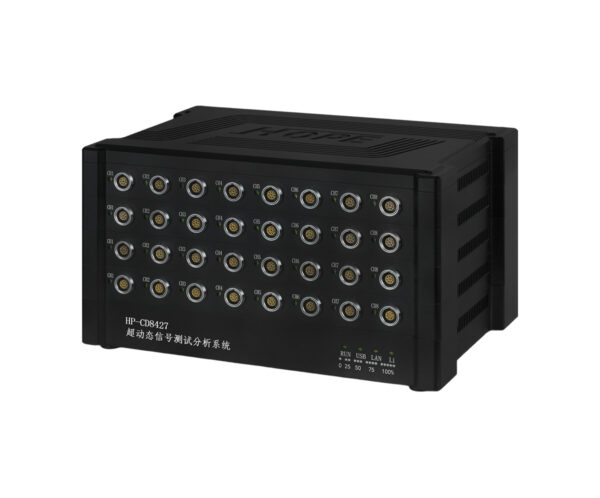
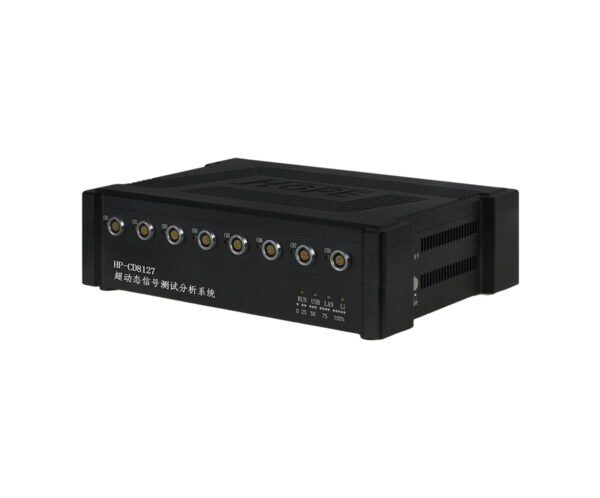
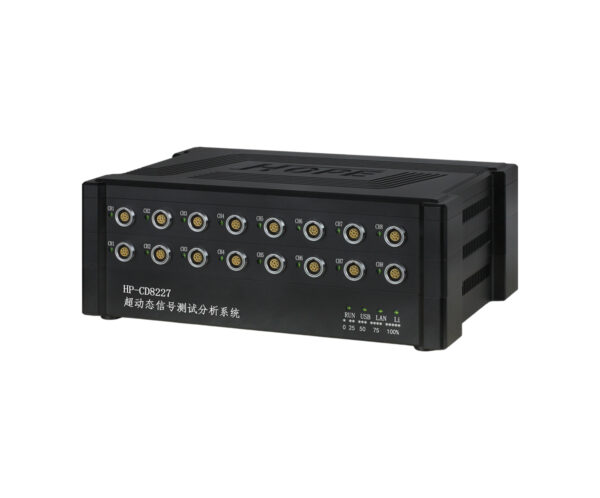
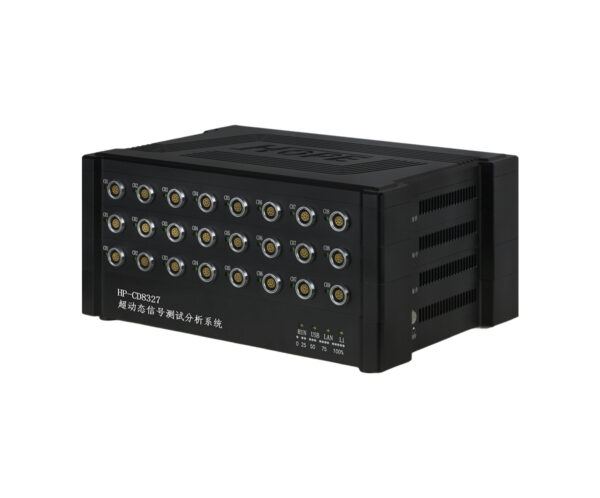
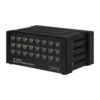
The HP-CD Series is an ultra-high-speed dynamic signal data acquisition and analysis system designed for harsh / strong electromagnetic interference (EMI) environments. Each channel can connect different sensors at the same time to capture dynamic temperature, heat flux density, vibration/acceleration, and more. All channels support synchronous acquisition, display, and storage, with a maximum sampling rate up to 20 MHz.
| Mixed sensor input (true multi-purpose DAQ) | In strong EMI environments, each channel can connect different sensors simultaneously to complete dynamic measurements such as temperature, heat flux density, vibration/acceleration, etc. |
|---|---|
| Ultra-high-speed synchronous sampling (up to 20 MHz) | All measurement points support synchronous sampling, real-time display, and data logging. Sampling rate is software configurable. |
| Built-in excitation output | Provides 24 V constant-voltage excitation. |
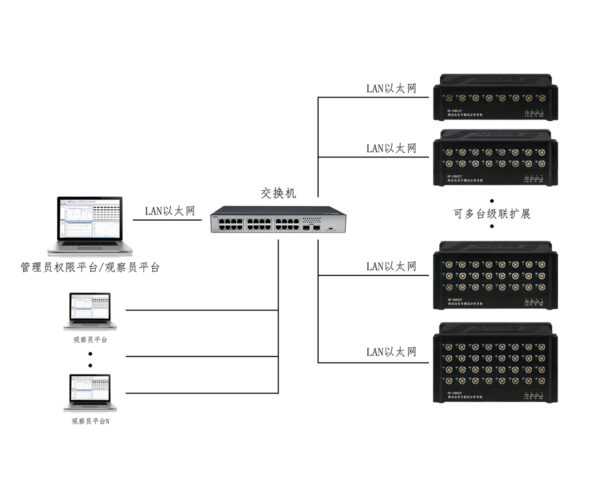
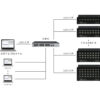
| Modular & lightweight (scalable test system) | Modular design makes it easy to carry and deploy. Measurement points can be customized, and multiple units can be networked to build large-scale test systems. |
| Flexible power options for field tests | Supports AC 220V / 50Hz or DC 12V. Optional 12V lithium battery supports 4+ hours standalone runtime—ideal for outdoor, blast, or shock-impact testing. |
| Item | Specification |
|---|---|
| Input channels | 8–32 channels per unit; multi-unit networking supports thousand-channel test systems |
| Sampling rate | 1 Hz–20 MHz, software configurable; all channels synchronous parallel sampling |
| ADC resolution | 18-bit |
| Measurement accuracy | ±0.2% (custom 0.1% available) |
| Signal bandwidth | 1–3 MHz |
| Bridge (strain gauge) | Full bridge / half bridge / quarter bridge; 120 Ω & 350 Ω bridge arm resistors |
| Voltage input (AC/DC) | ±5 mV, ±10 mV, ±50 mV, ±100 mV, ±500 mV, ±1 V, ±5 V, ±10 V |
| Current input | ±40 mA, ±80 mA, 1–20 mA, 4–20 mA; no external shunt required; min resolution 0.1 μA |
| Dynamic sensors | Acceleration / velocity: magnetic, resistive, capacitive, IEPE/ICP, etc. |
| Programmable excitation (CV) | 0–12 VDC / 50 mA, software programmable; 1 mV step; accuracy 0.04% ± 1 mV |
| Programmable excitation (CC) | 0.001–50 mADC, software programmable; 1 μA step; accuracy 0.05% ± 2 μA |
| Fixed excitation | 24 VDC / 40 mA, ±15 VDC / 50 mA |
| IEPE constant current | Built-in 4 mA (±10%) IEPE current source + conditioning; 24 V compliance |
| Communication interfaces | USB 3.0 and Gigabit Ethernet |
| Data storage | Built-in 1 TB SSD, real-time cache storage; SSD data accessible via external monitor; optional dual-protection storage with control PC |
| Power (battery) | Each module built-in 8.4V 3.5Ah (4+ hrs off-grid); optional baseboard 8.4V 30Ah (up to 12+ hrs) |
| Embedded OS | Linux |
| Trigger functions | Software trigger / internal trigger / external trigger / ± delay; fast recognition for level, rising edge, falling edge sync triggers |
Blast / shock / impact testing (field deployment + battery runtime)
Vibration & acceleration testing (IEPE/ICP sensors)
Heat flux & temperature transient measurement
High-speed dynamic signal capture in strong EMI environments
Multi-channel structural testing and large-scale monitoring via networking
A high speed data acquisition system (high speed DAQ) is used to capture fast transient signals that standard data loggers may miss. The HP-CD Series is built for dynamic signal testing in harsh environments, including shock/impact, vibration/acceleration, and transient temperature/heat-flux measurements, with high-speed synchronous sampling up to 20 MHz.
HP-CD supports 1 Hz to 20 MHz sampling rate (software configurable). All channels can run synchronous parallel sampling, enabling accurate time alignment for impact and transient tests.
Yes. For dynamic testing, HP-CD works as a high speed data logger with synchronized sampling, real-time display, and local storage options—ideal for capturing short-duration events like shock, blast, and rapid vibration changes.
Yes. HP-CD is designed for strong EMI environments where cable noise and interference can degrade measurement quality. It is commonly deployed in demanding field tests requiring stable acquisition under heavy electromagnetic disturbance.
One HP-CD unit supports 8–32 channels. Multiple units can be networked to build a large channel-count system (including thousand-channel deployments) based on project architecture.
HP-CD supports mixed sensor inputs, including:
Strain gauge bridges (full/half/quarter; 120Ω & 350Ω)
Voltage (AC/DC) signals
Current signals (0–20 mA / 4–20 mA and other ranges)
IEPE/ICP dynamic sensors (accelerometers) and other vibration/response sensors
Yes. HP-CD includes a built-in IEPE constant current source (4 mA ±10%) and conditioning, with 24 V compliance voltage, making it suitable for IEPE/ICP accelerometer vibration and impact testing.
HP-CD supports multiple excitation options:
Programmable constant voltage: 0–12 VDC / 50 mA (1 mV step; accuracy 0.04% ±1 mV)
Programmable constant current: 0.001–50 mA (1 μA step; accuracy 0.05% ±2 μA)
Fixed excitation: 24 VDC / 40 mA, ±15 VDC / 50 mA
This covers common sensor powering needs for dynamic testing.
HP-CD supports software trigger, internal trigger, and external trigger, with sync recognition including level, rising edge, and falling edge. This helps ensure reliable capture of sudden events such as shock and blast tests.
HP-CD supports 1–3 MHz signal bandwidth (depending on configuration), which is critical for measuring high-frequency dynamic content in transient and vibration signals.
HP-CD can be configured with built-in local SSD storage (e.g., 1 TB) for real-time caching and logging. Data can be accessed through supported display/monitor methods, and optional dual-protection storage with a control PC is available for high-value tests.
Yes. HP-CD provides USB 3.0 and Gigabit Ethernet, supporting high-speed data transfer and multi-unit networking.
Yes. HP-CD supports AC 220V / 50Hz or DC 12V. Battery options include:
built-in 8.4V 3.5Ah per module (typically 4+ hours off-grid)
optional 8.4V 30Ah base battery (typically 12+ hours off-grid)
Standard accuracy is ±0.2%, and custom ±0.1% configurations are available depending on project requirements and measurement setup.
No. HP-CD supports multiple current ranges (including 0–20 mA and 4–20 mA) without external shunts, and provides fine resolution down to 0.1 μA.
HP-CD is often used for:
blast / shock / impact testing
vibration & acceleration measurement (IEPE/ICP)
high-speed transient capture in EMI environments
dynamic thermal tests (temperature & heat flux density)
multi-channel synchronized testing with scalable channel counts