
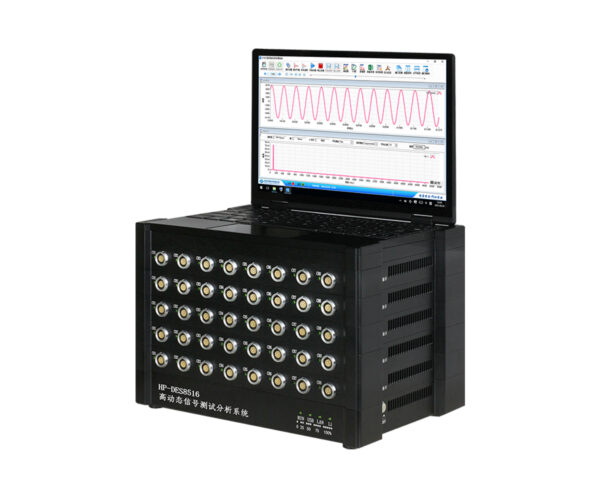
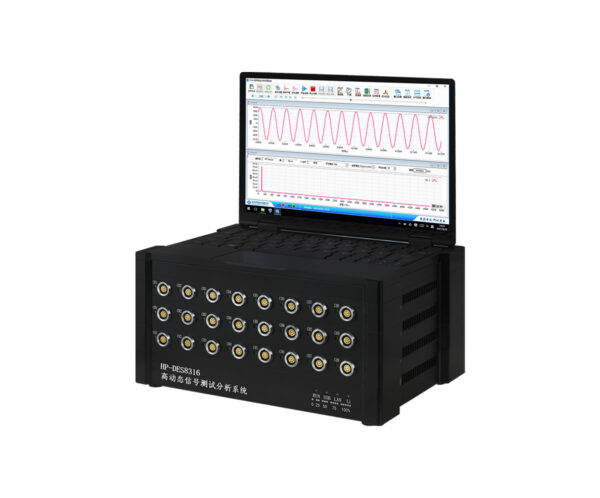
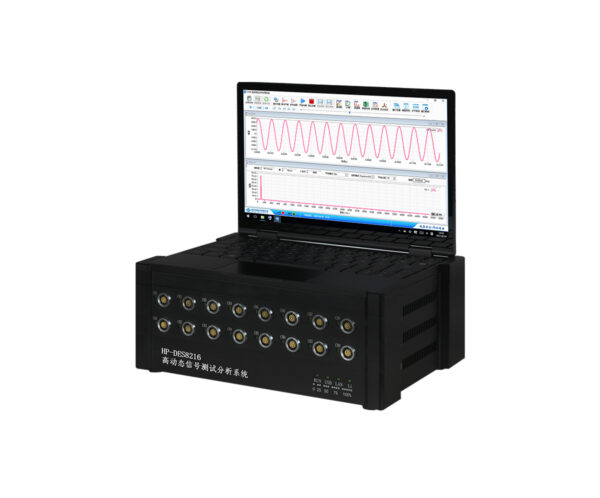


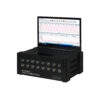

HP-DES is a high-speed, multi-channel dynamic signal DAQ and analysis system with synchronous parallel sampling up to 1 MHz, universal mixed inputs, and an integrated Windows platform (12th Gen i7 / 16GB RAM / 1TB SSD / 10″ capacitive touchscreen) for independent on-site acquisition and data management.
| Universal mixed inputs (true multi-signal) | Each input channel can select different analog measurement types (strain, voltage, current, etc.) without extra auxiliary modules. |
|---|---|
| High-speed synchronized acquisition | All channels sample/display/save synchronously; maximum sampling rate up to 1 MHz, with 1 Hz step adjustment in software. |
| Online self-calibration for long-term stability | Automatically compensates for environmental temperature/humidity effects, time drift, and temperature drift—improving measurement stability over long tests. |
| Hardware auto-balance (zero) without losing range | Automatically adjusts bridge zero to keep full-scale symmetry; supports TEDS and intelligent cable functions. |
| Automatic fault diagnosis | Detects front-end sensor issues such as short/open circuit, saturation/over-range, and full-scale faults, then provides troubleshooting guidance. |
Built for higher-bandwidth measurements, HP-DES combines synchronized multi-channel acquisition with long-term stability features such as online self-calibration, hardware auto-balance, and automatic fault diagnosis. The integrated Windows touchscreen design helps simplify field operation and reduces dependence on external PCs, while built-in SSD storage supports safer data capture and backup.
High-speed vibration, shock, and transient testing (IEPE/ICP sensors)
Dynamic strain measurement requiring higher sampling bandwidth
Multi-channel synchronized data capture for R&D and durability testing
On-site testing workflows needing Windows touchscreen operation + local SSD storage
Bridge / Strain: Full bridge, half bridge, quarter bridge; bridge arm resistance 120 Ω / 350 Ω per channel
Voltage (AC/DC ranges): ±5 mV, ±10 mV, ±50 mV, ±100 mV, ±500 mV, ±1 V, ±5 V, ±10 V
Current: ±40 mA, 1–20 mA, 4–20 mA (no external shunt resistor required)
Acceleration / Velocity: magnetic, resistive, capacitive, IEPE / ICP, etc.
| Parameter | Specification |
|---|---|
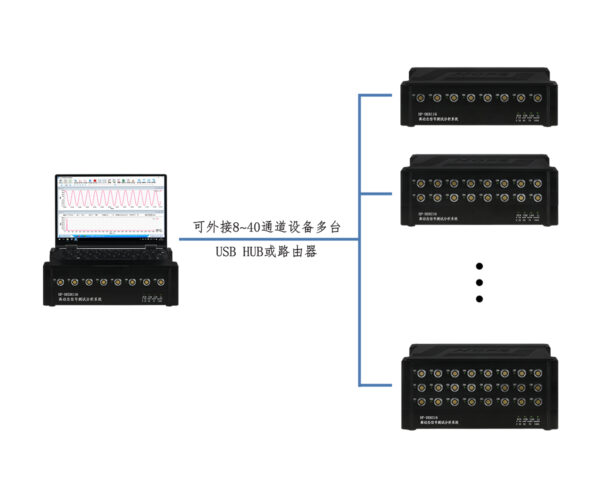
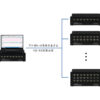
| Channels / measurement points | 8–40 channels per unit; multi-unit networking supports 1000+ channels |
| Sampling rate | All channels synchronous parallel sampling; 1 Hz–1 MHz software set |
| Measurement accuracy | ±0.1% (optional customized 0.05%) |
| Excitation – programmable constant voltage | 0–12 VDC / 50 mA, software programmable; 1 mV step; accuracy 0.04% ± 1 mV |
| Excitation – programmable constant current | 0.001–50 mADC, software programmable; 1 µA step; accuracy 0.05% ± 2 µA |
| Fixed excitation outputs | 24 VDC / 40 mA, ±15 VDC / 50 mA |
| IEPE constant current | Built-in 4 mA ± 10% constant current + conditioning; compliance voltage 24 V |
| Dynamic range | 108 dB @ 1 kS/s @ 10 V range |
| On-board storage | Built-in 1 TB SSD; real-time data backup; SSD data accessible via external monitor |
| Dual-storage safeguard | Optional: device + control PC dual-storage to prevent data loss during tests |
| Embedded system | Windows system; 12th Gen i7, 16GB RAM, 1TB SSD, 10″ capacitive touchscreen |
| ADC resolution | 18-bit (SAR / successive-approximation type) |
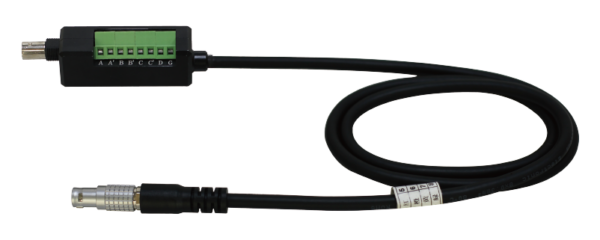
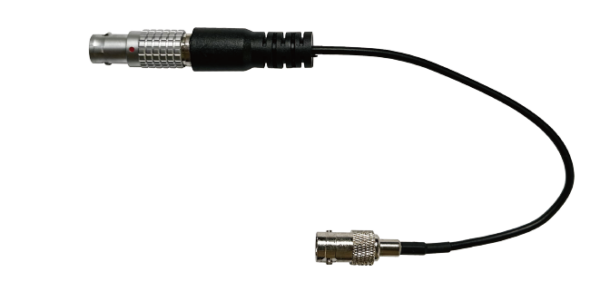
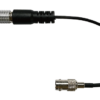
| Optional accessories | Strain signal input cable (optional); Voltage signal input cable (optional) |
Q1: When should I choose HP-DES instead of HP-DAS or 256 kHz systems?
Choose HP-DES when you need higher bandwidth (up to 1 MHz) while also wanting an integrated Windows touchscreen for independent on-site operation.
Q2: Does HP-DES support IEPE / ICP accelerometers?
Yes. Built-in 4 mA constant current and conditioning support common IEPE/ICP sensors.
Q3: How is data protected during long acquisitions?
A built-in 1TB SSD provides real-time backup, and an optional dual-storage strategy with the control PC helps prevent data loss.